Table of Contents
- Understanding Birthright Citizenship and the 14th Amendment
- Citizenship for Children Born Abroad via Surrogacy
- Consular Report of Birth Abroad Requirements
- DNA Testing for Surrogacy Citizenship Verification
- U.S. Passport Application for Newborns
- Legal Parentage and Surrogacy Contracts
- Post-Birth Legal Hurdles and Emergency Travel
- Dual Citizenship Complexities
- Frequently Asked Questions
Last Updated: September 21, 2026
Understanding Birthright Citizenship and the 14th Amendment
The path to citizenship for children born via surrogacy begins with understanding how the 14th Amendment establishes birthright citizenship in the United States. The 14th Amendment grants citizenship to all persons born in U.S. territory, regardless of parental citizenship status. However, when a child is born abroad through surrogacy, the rules shift significantly, and the process becomes more complex.
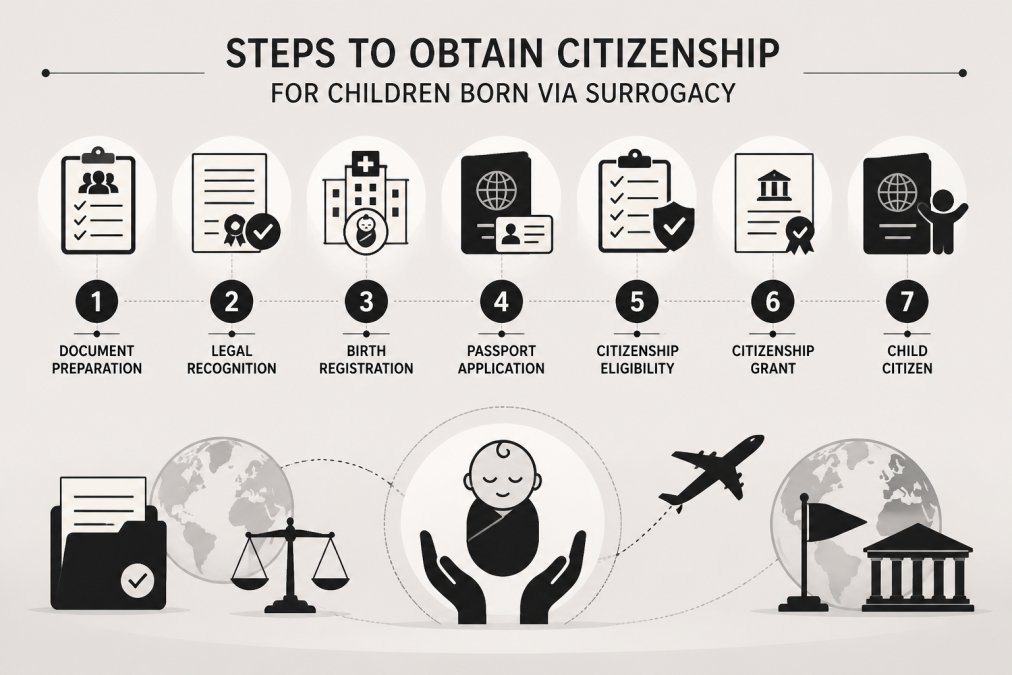
For Intended Parents pursuing international surrogacy, birthright citizenship applies automatically to children born on U.S. soil, but children born abroad face additional documentation and legal requirements that determine which steps to obtain citizenship for children born via surrogacy you’ll need to follow.
Most Intended Parents don’t realize that citizenship isn’t automatic for surrogacy-born children, even when one or both parents are U.S. citizens. The complexity lies in paperwork and timing, and this misconception leads to delays and costly corrections later.
Start citizenship planning before the birth, not after. The sooner you establish legal parentage, the sooner you can begin the citizenship documentation process. Waiting creates complications that are harder to untangle.
Citizenship for Children Born Abroad via Surrogacy
When your child is born abroad through surrogacy, citizenship transmission depends on parental citizenship status and physical presence in the United States. The law requires that at least one parent be a U.S. citizen at the time of birth, and that parent must have accumulated physical presence in the country before the child’s birth, typically five years after age 14. For Intended Parents using surrogacy internationally, this requirement is often satisfied, but verification is critical.
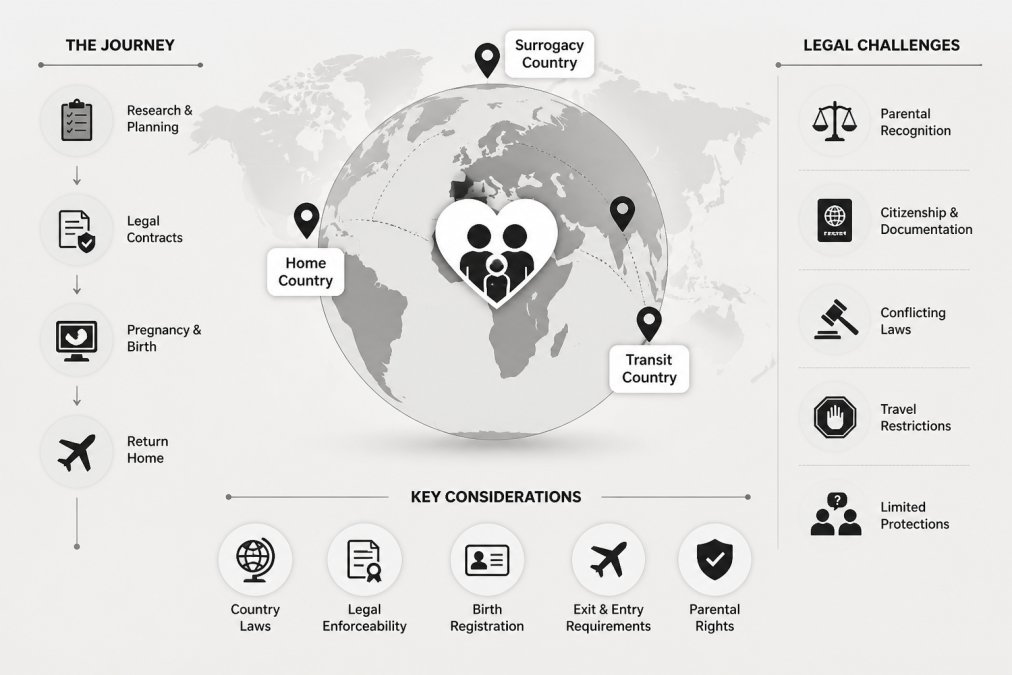
The steps to obtain citizenship for children born via surrogacy abroad begin with establishing legal parentage. Without a court order or pre-birth order recognizing you as the legal parent, the consular officer cannot process citizenship transmission. Different countries have different rules about recognizing Intended Parents on the birth certificate, some list them automatically; others list the gestational carrier. Understanding your specific surrogacy destination’s laws is non-negotiable.
Never assume your country of birth will recognize you as the legal parent automatically. Many surrogacy destinations require a separate court order to establish parental rights. Without this, you cannot proceed with U.S. citizenship applications.
Consular Report of Birth Abroad Requirements
The Consular Report of Birth Abroad (CRBA) is the primary document that establishes citizenship for a child born outside the United States to a U.S. citizen parent. Filing for a CRBA is often the first formal step in the citizenship process for surrogacy-born children.
To file for a CRBA, visit a U.S. embassy or consulate in the country where your child was born. The consular officer will review your documentation, verify your citizenship, and confirm legal parentage.
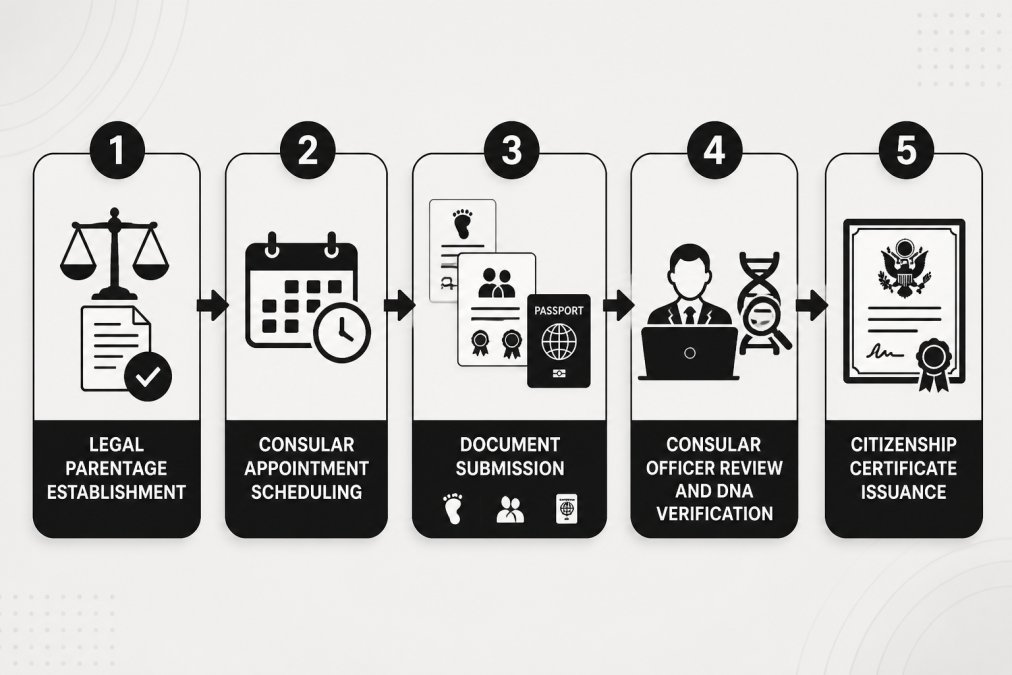
Required documents for CRBA filing include your U.S. passport, the child’s birth certificate from the surrogacy country, proof of legal parentage (court order or pre-birth order), and the gestational carrier’s documents in some cases. Contact your specific consulate before traveling, as each embassy maintains slightly different requirements and fee structures.
The CRBA is not a passport, it’s a citizenship certificate that proves your child’s citizenship status. You’ll use the CRBA to apply for a U.S. passport afterward.
DNA Testing for Surrogacy Citizenship Verification
DNA testing has become standard practice for establishing biological relationships in surrogacy citizenship cases. Consular officers use DNA evidence to verify that at least one Intended Parent is biologically related to the child, particularly in gestational surrogacy.
When DNA Testing Is Required
The requirement for DNA testing depends on your family structure and the surrogacy arrangement:
- Gestational surrogacy with one biological parent: DNA testing is typically required to confirm the biological relationship between the child and the U.S. citizen parent. This is the most common scenario and consular officers routinely request testing.
- Gestational surrogacy with no biological parent: When neither intended parent is biologically related to the child (as in cases where both partners are male or when using a donor egg and donor sperm), DNA testing cannot establish a biological link. Instead, consular officers require additional documentation: the surrogacy contract, court orders establishing parental rights, and sometimes affidavits from the gestational carrier confirming the arrangement. The burden of proof shifts entirely to legal documentation.
- Traditional surrogacy: When the gestational carrier is also the biological mother, DNA testing may be waived if the intended parent’s biological relationship is already established through other means.
The Testing Process and Timeline
The test is a simple cheek swab from both the Intended Parent and the child, collected at the U.S. embassy or consulate or at an approved facility. Results typically come back within 1-2 weeks. The consulate will arrange testing or provide a list of approved laboratories; you cannot use a private DNA testing service.
Cost and Who Pays
Confirm payment responsibility in your surrogacy contract before birth.
What Happens If Testing Is Delayed or Inconclusive
If DNA results are delayed, your CRBA filing is paused until the biological relationship is confirmed. Plan for this by scheduling your consular appointment with buffer time before any planned travel. Inconclusive results are rare but may require a second test.
DNA Testing Does Not Replace Legal Documentation
It is critical to understand that DNA testing confirms a biological relationship but does not establish legal parentage. You still need court orders establishing parental rights, birth certificates, and surrogacy contracts. The DNA test simply provides biological evidence that supports your legal claims. Without legal documentation, a positive DNA test alone is insufficient for citizenship processing.
Schedule DNA testing as part of your consular appointment preparation, not as an afterthought. Delays in testing directly delay citizenship issuance. Confirm the consulate’s approved testing facilities and any specific requirements (such as notarization of samples) before your appointment.
U.S. Passport Application for Newborns
Once you have the CRBA, apply for a U.S. passport at a passport acceptance facility (post office, courthouse, or library). For newborns, both parents must appear in person with the child. The steps to obtain citizenship for children born via surrogacy are incomplete without securing a passport. (Source: Department of State’s Bureau of Consular Affairs)
Required documents include the CRBA, proof of citizenship for both parents, and a completed passport application form. You’ll also need an acceptable newborn photo, which must meet specific standards.
The passport is valid for five years for children under 16.
Apply for your child’s passport as soon as you receive the CRBA. Don’t wait. International travel plans often come up unexpectedly, and having the passport ready prevents last-minute complications.
Legal Parentage and Surrogacy Contracts
Establishing legal parentage is the foundation of every step to obtain citizenship for children born via surrogacy. Legal parentage can be established through pre-birth orders (recognizing Intended Parents from birth), post-birth orders (requiring court process after delivery), or direct recognition on the birth certificate if the surrogacy contract is properly executed.
Your surrogacy contract must be carefully drafted to reflect your jurisdiction’s laws. A poorly written contract creates ambiguity about legal parentage, complicating every downstream process. Work with attorneys experienced in both your surrogacy country’s law and U.S. immigration law.
The surrogacy contract should specify: that the gestational carrier relinquishes all parental rights; that Intended Parents assume all parental rights and responsibilities; the mechanism for establishing legal parentage; who covers legal and medical costs; and what happens if complications arise.
Post-Birth Legal Hurdles and Emergency Travel
After your child is born, unexpected legal complications can emerge despite careful planning: a gestational carrier might contest the agreement, local authorities might question legality, or a birth certificate might be delayed or incorrect. These scenarios are rare but require contingency plans.
Common Post-Birth Legal Complications
Gestational Carrier Contests or Delays Signing Documents
Local Authorities Question the Legality of Surrogacy
Emergency Travel Before Citizenship Documents Are Finalized
Preventing Post-Birth Complications
Never assume complications won’t happen. Even in countries with well-established surrogacy frameworks, delays and disputes occur. Having a contingency plan, a retained attorney, copies of all documents, and clear communication with the consulate, is the difference between a minor setback and a crisis.
Dual Citizenship Complexities
If your child is born in a country that grants birthright citizenship, they may automatically hold dual citizenship. Dual citizenship creates opportunities (living, working, and studying in either country without visa restrictions) and complications (potential tax obligations and military service requirements in the birth country). Some countries require renouncing one citizenship at adulthood; others allow dual citizenship indefinitely. The U.S. recognizes dual citizenship but doesn’t actively encourage it.
Frequently Asked Questions
Can a child born through surrogacy get birthright citizenship?
Yes, children born through surrogacy can obtain birthright citizenship if at least one Intended Parent is a U.S. citizen and meets specific physical presence requirements. Under the 14th Amendment, birthright citizenship applies to children born on U.S. soil to a citizen parent. For children born abroad via surrogacy, citizenship transmission is possible if the citizen parent meets statutory requirements for time spent in the U.S. before the child’s birth. Consult with an immigration attorney to confirm your specific situation, as requirements vary based on parental citizenship status and the child’s birthplace.
What documentation is required to prove citizenship for a child born via surrogacy?
Documentation requirements include the child’s birth certificate, the surrogacy contract, a court-ordered parentage establishment (pre-birth or post-birth order depending on jurisdiction), DNA testing results linking the Intended Parents to the child, and proof of the citizen parent’s physical presence in the U.S. For international births, a Consular Report of Birth Abroad (CRBA) serves as proof of citizenship. You will also need valid passports or identification for both Intended Parents and evidence of legal marriage (if applicable). An immigration attorney can guide you on jurisdiction-specific documents needed for your case.
Is a Consular Report of Birth Abroad (CRBA) always required?
A CRBA is required for children born abroad to prove U.S. citizenship when no birth certificate from a U.S. state exists. The CRBA is filed with the consular office in the country where the child was born and serves as official documentation of citizenship status. While not always mandatory for every situation, it is strongly recommended because it provides a clear, government-recognized record that simplifies passport applications, school enrollment, and future legal matters. Without a CRBA, you may face delays in obtaining a passport or establishing citizenship later.
How long does the citizenship process take after the baby is born?
The timeline varies significantly depending on jurisdiction, document completeness, and whether DNA testing is required. Delays may occur if documents are incomplete, DNA results are pending, or consular processing is backlogged. Starting the documentation process immediately after birth helps minimize delays.