Table of Contents
- What International Surrogacy Medical Screenings Actually Involve
- The Surrogacy Medical Screening Timeline: From Application to Clearance
- Surrogate Health Requirements: What Clinics Look For
- Medical Clearance for Surrogacy: What the Final Approval Means
- How to Prepare for Your Screening Appointment
- International-Specific Logistics: Records, Travel, and Coordination
- Emotional and Financial Preparation for the Screening Phase
- Frequently Asked Questions
Last Updated: September 17, 2026
What International Surrogacy Medical Screenings Actually Involve
Preparing for international surrogacy medical screenings starts with understanding one thing: this is a safety process, not a test you pass or fail. Clinics screen both Intended Parents and surrogate candidates to confirm everyone is healthy enough to move forward.
Screening for Intended Parents vs. Surrogate Candidates
The two sides of the process look nothing alike.
For Intended Parents, screening confirms you can produce viable embryos and carry the legal and emotional weight of the journey. Expect bloodwork, genetic testing, and a health history review.
- Full physical examination and diagnostic testing
- Infectious disease screening
- Hormonal assessment and ovarian reserve checks
- Uterine cavity evaluation, often via transvaginal ultrasound
- Psychological stability review
- Lifestyle requirements, including substance screening
Intended Parents are screened for readiness. Surrogate candidates are screened for capacity. Same word, very different depth.
The Surrogacy Medical Screening Timeline: From Application to Clearance
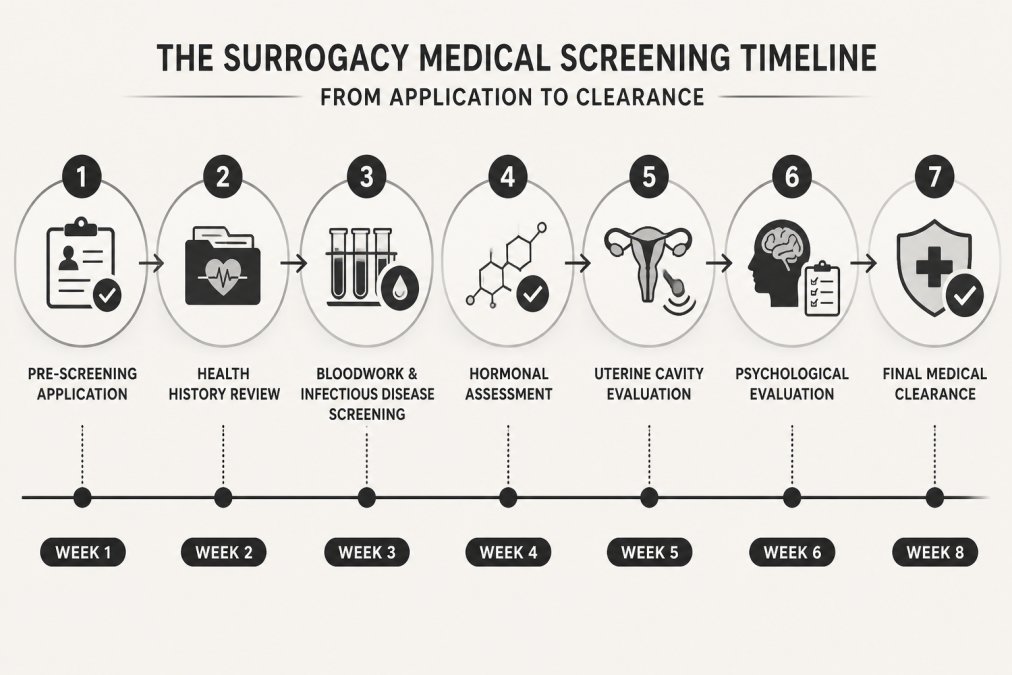
Most screening timelines run four to eight weeks from application to medical clearance. That range holds when records arrive on time and no follow-up testing is needed. Cross-border cases routinely land at the longer end, because records, labs, and travel have to clear two health systems instead of one.
Typical Stages and How Long Each Takes
| Stage | Typical Duration | What Happens |
|---|---|---|
| Pre-screening application | 1-3 days | Forms, consent, initial intake |
| Health history review | 3-7 days | Records collected and reviewed |
| Bloodwork and infectious disease screening | 1-2 weeks | Labs drawn, results returned |
| Hormonal assessment | 1-2 weeks | Often runs alongside bloodwork |
| Uterine cavity evaluation | 1 week | Imaging and clinical review |
| Psychological evaluation | 1-2 weeks | Interviews and written assessment |
| Final medical clearance | 3-7 days | Clinic signs off on the protocol |
The stages overlap more than this table suggests. A well-run clinic starts the psychological evaluation while bloodwork is still pending and books imaging the moment hormonal results land. Treat the table as a sequence of dependencies, not a queue.
What Actually Moves the Timeline
Four variables decide whether you finish in four weeks or eight:
- Record completeness. A missing prior surgical report or an unsigned release form can stall the health history review for a week on its own. Request records from every prior clinic, imaging center, and hospital, not just the ones you remember best.
- Lab routing. Some panels can be drawn at a local lab and shipped; others must be drawn at the fertility clinic. Confirm which is which before you book travel, because a misrouted sample means a redraw and a lost week.
- Translation turnaround. Records in another language need certified translation before the receiving clinic will review them. Build two to five business days into your plan for each document set.
- Cycle alignment. The uterine evaluation and any monitoring have to line up with the clinic’s calendar. If your travel window is narrow, tell the coordinator early so the schedule is built around it.
Ask your program coordinator for a written dependency map, which result unlocks which next step, before you start. Families who can see the chain rarely get surprised by a delay.
A Realistic Week-by-Week View
A typical cross-border sequence looks like this:
- Week 1: Application, consents, and record requests go out to every prior provider.
- Week 2: Records arrive, get translated if needed, and enter clinical review. Local labs are scheduled.
- Week 3: Bloodwork and infectious disease screening are drawn. Hormonal assessment runs in parallel.
- Week 4: Uterine cavity evaluation is booked. Psychological evaluation begins.
- Week 5: Results are consolidated. Any flagged value triggers a repeat test or specialist note.
- Week 6: Follow-up testing completes. The clinic reviews the full file.
- Week 7: Final medical clearance is issued and the protocol is signed.
If a result is flagged, add one to three weeks depending on what the clinic asks for. A repeat lab is quick; a specialist clearance can take longer. Knowing that range in advance keeps a flagged result from feeling like a crisis.
What Happens After the Screening Results
Once clearance is issued, the clinic moves to protocol scheduling, medication calendars, monitoring appointments, and the embryo transfer window. For cross-border journeys, this is also when travel dates get locked, so the screening timeline and the travel timeline have to be planned together rather than one after the other.
Surrogate Health Requirements: What Clinics Look For
Surrogate health requirements center on three things: a healthy reproductive system, a stable medical history, and a lifestyle that supports pregnancy. Clinics apply these standards consistently because the clinical protocol depends on them.
Physical Examination and Diagnostic Testing
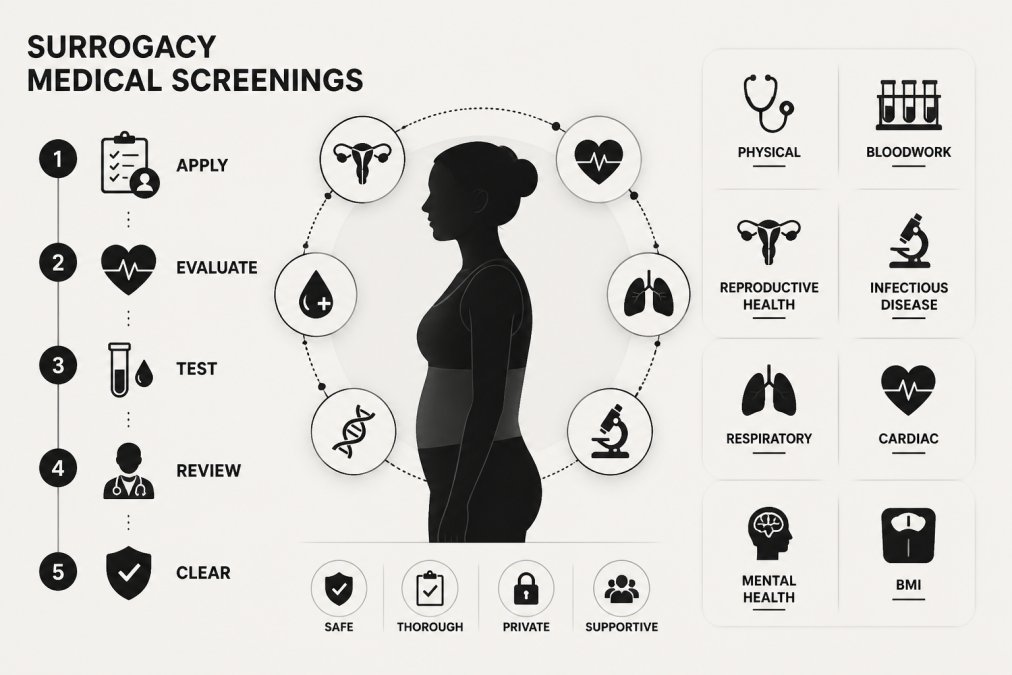
The physical exam is the foundation. A reproductive endocrinologist reviews body mass index, blood pressure, and overall health, then orders diagnostic testing.
Common tests include:
- Complete blood count and metabolic panel
- Infectious disease screening
- Hormonal assessment
- Ovarian reserve testing
- Transvaginal ultrasound for uterine health
- Genetic testing where indicated
Lifestyle and Psychological Stability Factors
Lifestyle requirements are not about perfection. They are about risk.
Skipping the psychological evaluation or treating it as a formality is a common mistake. Clinics can and do pause a match over unresolved mental health concerns, which delays everything.
Medical Clearance for Surrogacy: What the Final Approval Means
Medical clearance for surrogacy is the clinic’s written confirmation that a candidate meets every clinical eligibility standard and can begin the protocol. It is the green light, not a guarantee of pregnancy. (Source: mental health screening guidelines)
Clearance usually covers:
- All lab results reviewed and within range
- Physical examination completed
- Psychological evaluation passed
- Any flagged issues resolved or explained
- A signed clinical protocol ready to start
How to Prepare for Your Screening Appointment
Preparation is where Intended Parents gain the most control. The clinics that move fastest are the ones that receive complete files, and the families who handle a flagged result best are the ones who planned for it before the appointment.
The Document and Lab Checklist
Do these before your appointment:
- Request all medical records from every prior clinic, imaging center, and hospital
- Ask for records in the format the receiving clinic accepts
- Confirm which labs must be drawn locally versus on site
- Gather a full medication and supplement list
- Write out your family health history
- Get translations certified if records are not in English
- Book labs early so results arrive before your visit
Ask the clinic for its records checklist in writing before you request anything. Clinics reject files for small format issues, and a rejected file can add a week or more to your timeline.
Preparing for a Flagged or Failed Result
Most screenings clear without drama, but a flagged value is not rare, and it is not the same as a disqualification. A common pattern is a single out-of-range lab that the clinic wants repeated, or a health history detail that needs a specialist note before the file can move forward.
Prepare for that possibility before it happens:
- Ask your program coordinator what a flagged result typically means in your clinic’s process, and what the usual next step is.
- Have a plan for how you will handle a delay, a short pause, a repeat test, or a specialist referral, so a phone call does not feel like a verdict.
- Lean on your support network. Waiting is the hardest part of screening, and it is easier when you are not waiting alone.
Financial Preparation for the Screening Phase
Screening costs vary widely by clinic and country, so ask for a written breakdown rather than an estimate. Before you commit, get clear answers to these questions:
- Which tests are included in your program fee, and which are billed separately?
- Who covers travel, lodging, and any monitoring appointments during the screening phase?
- What happens if a retest or specialist visit is required, is that an additional cost?
- Does your coverage extend to a failed screening, or does the process restart?
- Are translation and records-collection fees included or separate?
International-Specific Preparation
Cross-border screening adds layers that domestic programs never face. Before your appointment, confirm:
- Record transfer. Your local provider and the fertility clinic need a signed release that both sides accept. Ask for the exact form rather than assuming a standard one will work.
- Lab logistics. If bloodwork is drawn locally and shipped, confirm the shipping method, the receiving lab’s requirements, and the turnaround time.
- Travel alignment. Screening appointments and monitoring visits have to line up with the clinic’s calendar. Book refundable travel where possible, and keep a buffer day on each side.
- Coordination. Someone has to manage the handoffs between your local doctor, the fertility clinic, and your legal team. If that is not you, confirm who it is before the first appointment.
International-Specific Logistics: Records, Travel, and Coordination
Cross-border screening adds layers that domestic programs never face. Records cross borders, labs run in different systems, and travel has to line up with cycle dates.
The biggest friction points:
- Medical records in another language need certified translation
- Bloodwork may need to be drawn locally and shipped, which affects timing
- Travel has to match the clinic’s monitoring schedule
- Coordination between your local doctor, the fertility clinic, and your legal team has to be managed by someone
Emotional and Financial Preparation for the Screening Phase
Two things derail families during screening: emotions and money.
Ask your program coordinator what a flagged result typically means before you get one. Knowing the likely next step in advance turns a scary phone call into a manageable one.
Financially, understand what screening covers before you commit. Ask directly:
- Which tests are included in your program fee?
- Which are billed separately?
- What happens if a retest is required?
- Does your coverage extend to a failed screening?
Frequently Asked Questions
What is included in the medical screening process for surrogacy?
Medical screenings for surrogacy typically include a health history review, physical examination, bloodwork, infectious disease screening, hormonal assessment, uterine cavity evaluation via transvaginal ultrasound, and psychological evaluation. For intended parents, screenings may involve genetic testing and fertility assessments. The exact protocol depends on the fertility clinic and the country where the surrogacy takes place. These steps confirm that both parties meet clinical eligibility and can proceed safely.
How long does the medical screening process take for international surrogacy?
The surrogacy medical screening timeline varies by clinic and country, but most screenings take several weeks to a few months from initial application to medical clearance. Factors include how quickly medical records are gathered, appointment availability, and whether follow-up testing is needed. Working with a coordinator who understands international logistics can help reduce delays and keep the process moving.
What are the key surrogate health requirements?
Surrogate health requirements generally include a healthy body mass index, no history of certain medical conditions, negative infectious disease screening, and a normal uterine cavity evaluation. Clinics also assess psychological stability and lifestyle factors. Age limits and specific criteria vary by clinic and country, so your agency or reproductive endocrinologist will provide the exact checklist for your program.
What happens if a surrogate does not pass the medical screening?
If a surrogate candidate does not pass the medical screening, the clinic will explain which criteria were not met. In some cases, treatable issues can be addressed and the candidate may be reconsidered. Otherwise, the agency will typically help match intended parents with another surrogate. This is why thorough pre-screening and transparent communication from your agency matter, so you understand the next steps without delays.