Table of Contents
- Understanding the Legal Framework and Your Rights
- Key Questions to Ask a Surrogacy Agency
- Building Your Surrogacy Agency Vetting Checklist
- Evaluating Agency Transparency and Pricing
- The Matching Process and Travel Logistics
- Post-Birth Legal Exit Strategies and Insurance
- Frequently Asked Questions
Last Updated: September 18, 2026
Understanding the Legal Framework and Your Rights
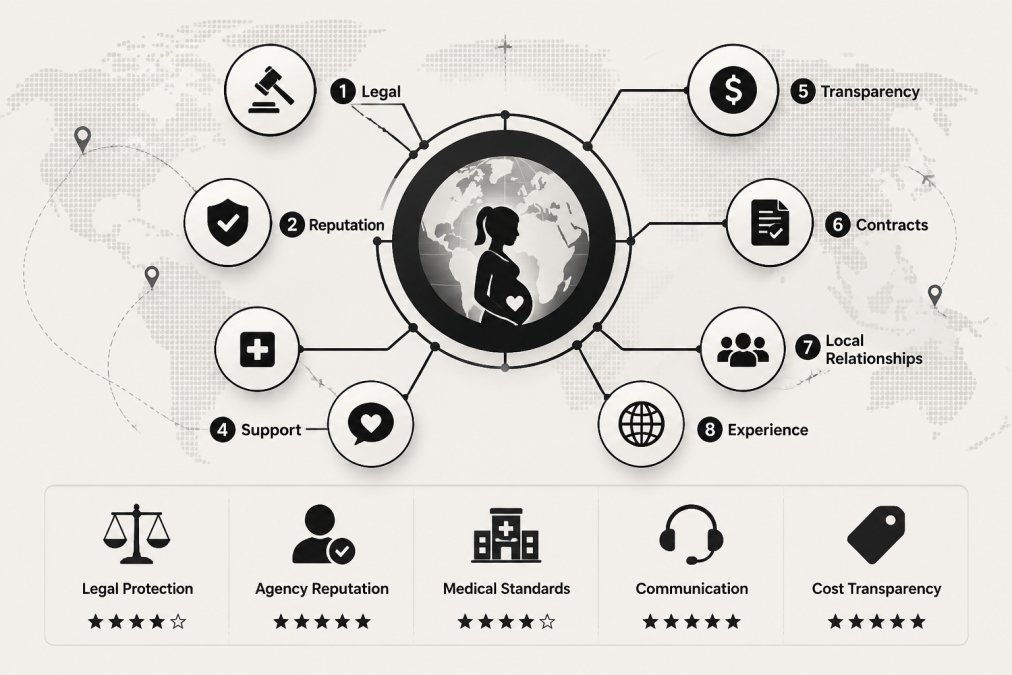
Choosing an [international surrogacy agency](/how-to-find-international-surrogacy-agencies/) is one of the most consequential decisions you’ll make on your path to parenthood. Your legal rights, your child’s citizenship status, and your family’s safety all depend on selecting an agency that understands the complex legal landscape.
The legal framework governing international surrogacy varies dramatically by destination country. A reputable international surrogacy agency should have deep expertise in the specific legal requirements of the countries where it operates, including how parental rights are established, what documentation is required for birth certificates, and how citizenship is determined for children born via surrogacy.
Many Intended Parents assume all agencies follow the same legal protocols. Some operate in jurisdictions with minimal legal oversight; others partner with fertility clinics and legal counsel in countries with well-established surrogacy frameworks. This difference can mean the difference between bringing your child home smoothly and facing legal complications.
When evaluating an international surrogacy agency, ask directly about their legal counsel’s credentials and experience in your home country’s immigration and family law. Your agency should be able to explain, in detail, how they’ll secure parental rights before the baby is born, what happens with the birth certificate, and exactly what steps are required to exit the country with your child.
The legal framework is not standardized across surrogacy destinations. Your agency’s legal expertise in your specific home country and chosen destination is non-negotiable.
Key Questions to Ask a Surrogacy Agency
Agency Experience and Track Record
How long has the agency been operating? How many successful surrogacy journeys have they completed? These metrics indicate whether the agency has weathered complications and built sustainable relationships with fertility clinics and legal partners.
A credible international surrogacy agency should provide transparent data about case volume, success rates, and average timeline from initial consultation to birth, and connect you with past Intended Parents who can speak to their experience.
Ask about their experience with your family structure. If you’re a single man, a same-sex couple, or an unmarried partner, the agency should have a track record of successfully supporting families like yours. Red flags include vague responses like “we can probably figure something out” or “we’ve never done that before, but we’re willing to try.”
Surrogate Screening and Medical Standards
A rigorous surrogate screening process protects both the surrogate’s health and your child’s wellbeing. Ask what medical clearances and psychological evaluations surrogates must complete before matching, whether DNA testing is required, and how the agency verifies medical history and fertility status.
A thorough international surrogacy agency will have protocols for surrogate health screening that exceed minimum legal requirements and explain how they assess emotional readiness and provide ongoing psychological support.
Ask whether the agency requires surrogates to undergo psychological evaluation before matching and again during pregnancy. Some agencies skip this step to move faster. That’s a warning sign.
A surrogate without proper medical and psychological clearance puts your child’s health and your legal protections at risk. Speed should never override screening rigor.
Transparency in Costs and Contracts
Many Intended Parents discover hidden fees after becoming emotionally invested. A transparent international surrogacy agency should provide a detailed cost breakdown upfront, including agency fees, surrogate compensation, medical costs, legal fees, travel, and contingency expenses.
Ask: What happens if the surrogate miscarries or backs out? Who covers additional medical costs? Are there escrow protections for your funds?
A reputable agency will have clear written answers and explain which costs are fixed and which may vary. Vague language like “costs depend on the situation” is a red flag.
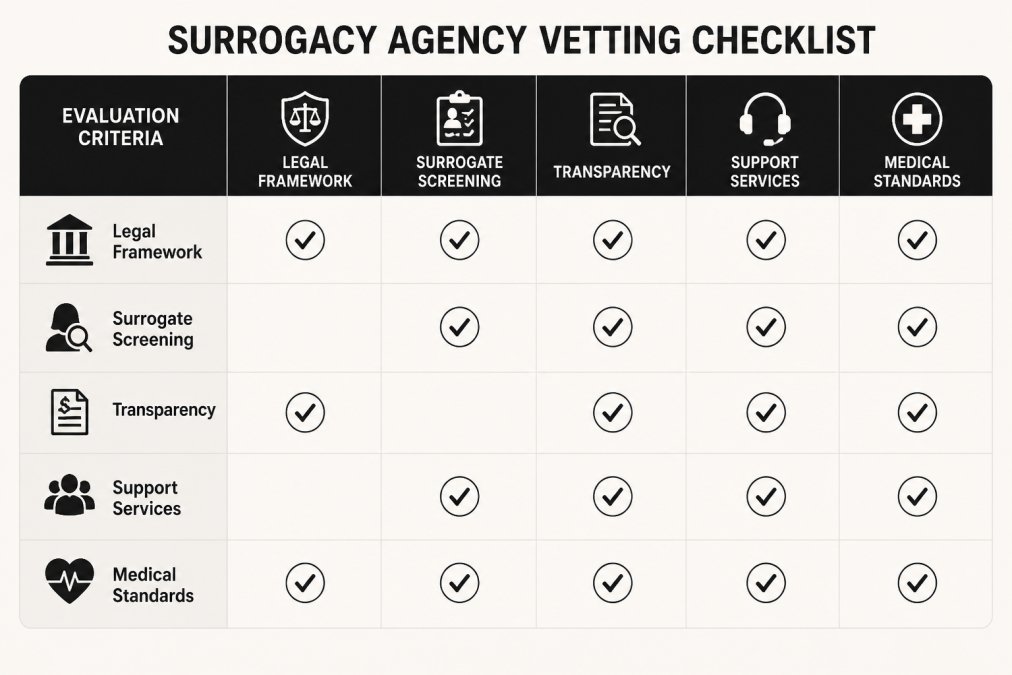
Building Your Surrogacy Agency Vetting Checklist
| Evaluation Criteria | What to Verify | Red Flags |
|---|---|---|
| Legal Expertise | Agency has licensed attorneys in your home country and destination country | Vague legal explanations, no attorney references |
| Surrogate Screening | Medical clearance, psychological evaluation, DNA testing documented | Minimal screening, pressure to move fast |
| Cost Transparency | Itemized breakdown, escrow protections, contingency policies | Hidden fees, vague pricing, pressure to pay upfront |
| Medical Standards | Fertility clinic credentials, embryo transfer protocols, prenatal care | Unaccredited clinics, minimal medical oversight |
| Communication | Regular updates, assigned case manager, clear escalation process | Delayed responses, no dedicated contact |
| Support Services | Emotional support, travel coordination, post-birth assistance | Minimal support after birth, no counseling |
| Track Record | Verifiable case volume, success rates, client references | Unwilling to share data, no references available |
| Matching Process | Detailed profile exchange, time to match, compatibility assessment | Rushed matching, minimal information about surrogate |
Legal Counsel and Parental Rights Protection
Your agency must have licensed legal counsel in both your home country and destination country, specializing in family law and surrogacy.
Ask your agency’s legal team to walk you through the exact sequence of legal steps from embryo transfer through bringing your child home, including when parental rights are established, what documentation is required, and how long the process takes.
A strong international surrogacy agency will explain how they handle post-birth legal exits, including visa applications, citizenship documentation, and home country immigration requirements.
Medical and Emotional Support Services
A comprehensive international surrogacy agency should provide psychological support for Intended Parents before, during, and after pregnancy, including counseling and access to mental health professionals who specialize in fertility.
Ask what medical support is available if complications arise, whether there is 24/7 access to the fertility clinic, and what the agency’s protocol is for medical emergencies.
Ask about post-birth support. The best agencies remain engaged through the legal exit process and beyond, helping you navigate citizenship, immigration, and the transition to parenthood.
Red Flags and Warning Signs
If an agency pressures you to decide quickly, claims they can guarantee a pregnancy outcome, refuses to provide client references, or is evasive about costs and legal processes, walk away.
Red flags also include agencies that don’t require thorough surrogate screening, claim to operate in legally restricted countries, or suggest circumventing legal requirements.
Be wary of agencies that position themselves as the only option for your situation or that claim competitors are unethical without evidence. Confidence in their own approach is good; dismissing all alternatives is a warning sign.
Evaluating Agency Transparency and Pricing
A reputable international surrogacy agency will provide clear, detailed information about every aspect of the process and every cost involved, and explain their business model.
Ask whether the agency has financial incentives that might bias recommendations, for example, higher commissions for certain fertility clinics or legal partners, or ownership of the fertility clinic. These should be disclosed.
A transparent agency will provide written documentation of all agreements, timelines, and financial arrangements in a contract you can review with your own attorney before signing.
Herman Family Group is committed to transparency, offering no hidden fees from the start.
The Matching Process and Travel Logistics
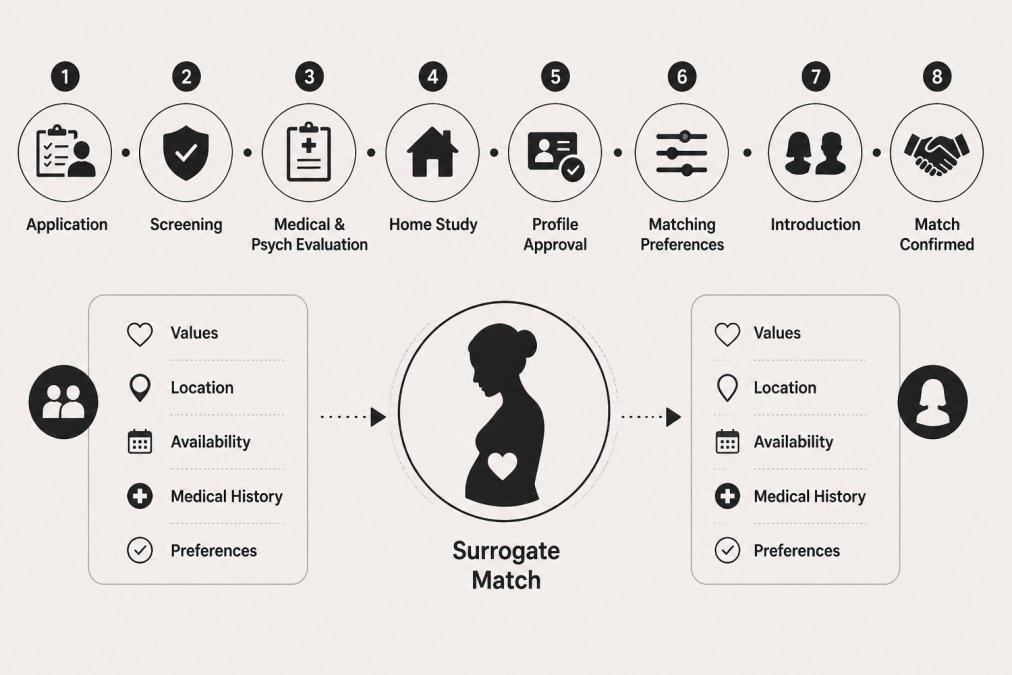
Ask how long matching typically takes, what information is exchanged, and whether you can communicate directly with your surrogate or if the agency mediates all contact.
Ask your agency for a detailed timeline showing every milestone from initial consultation through bringing your child home. This clarity helps you plan financially and emotionally for the journey ahead.
Post-Birth Legal Exit Strategies and Insurance
Many Intended Parents neglect planning for the post-birth phase. The legal exit, securing the birth certificate, establishing parental rights, obtaining citizenship documentation, and leaving the country with your child, can be more complex than the surrogacy itself. A strong international surrogacy agency should have a detailed post-birth legal strategy in place before the surrogate becomes pregnant.
Understanding the Post-Birth Legal Timeline
Immediate post-birth (Days 1-7). Within hours or days of birth, the surrogate will sign documents consenting to the transfer of parental rights to you. The timing and legal mechanism vary by country. Ask your agency: “What documents must the surrogate sign immediately after birth? Will this happen at the hospital or in court?” Your agency’s legal team should provide a written timeline specific to your destination country.
Medical and Health Insurance Complexities
Surrogate health insurance. Ask your agency: “What health insurance covers the surrogate during pregnancy and delivery? Who pays for her post-delivery care?” Verify whether surrogate health insurance is included in agency fees.
Post-Birth Support and Legal Coordination
Coordination with your home country’s embassy or consulate. Ask: “Will the agency contact my embassy on my behalf to clarify documentation requirements? Will the agency help me prepare the application?”
Red Flags in Post-Birth Planning
Agencies that claim post-birth legal processes are “simple” or “quick. If an agency minimizes the complexity or timeline, they are either inexperienced or being dishonest. Expect the process to take 60-120 days from birth to returning home with all necessary documentation.
Frequently Asked Questions
What legal protections should I look for in an international surrogacy agency?
Verify that the agency works with qualified legal counsel experienced in your destination country’s surrogacy laws and your home country’s citizenship and parental rights requirements. The agency should provide a detailed contract outlining parental rights, escrow account protections, and post-birth legal procedures including birth certificate acquisition and exit visa documentation. Ask for references from past Intended Parents and confirmation that the agency has handled cases involving your specific citizenship situation.
How can I verify the ethical standards and reputation of a surrogacy agency?
Request the agency’s track record with specific metrics: number of successful births, surrogate health screening protocols, and psychological evaluation standards. Check whether they maintain transparency about costs with no hidden fees, provide independent legal representation, and offer ongoing support through pregnancy and post-birth. Ask for client testimonials and references, and research whether the agency maintains ethical standards aligned with international surrogacy best practices and regulatory compliance.
What should I ask about surrogate screening and medical clearance during agency consultation?
Ask about the surrogate screening process including medical clearance requirements, psychological evaluation standards, health history review, and infectious disease testing. Confirm that all surrogates undergo fertility clinic evaluation and embryo transfer readiness assessment. Request details on how the agency ensures surrogate health throughout pregnancy, what insurance coverage is in place, and what happens if medical complications arise during pregnancy or delivery.
How do I know if an agency can handle my specific family situation?
Discuss your situation directly with the agency’s case management team and ask whether they have experience with families like yours, whether you’re single, same-sex, or facing other circumstances. Request specific examples of similar cases they’ve handled successfully. Ask about any additional legal or logistical considerations for your situation, and verify that the agency will not charge extra fees or treat your case as ‘complicated’ beyond standard service offerings.