Table of Contents
- How the IRS Treats International Surrogacy Payments
- IRS Medical Expense Deduction for Surrogacy: What Intended Parents Need to Know
- Surrogacy Tax Deduction Eligibility: Who Qualifies and How to Claim It
- Reporting Foreign Fertility Expenses to the IRS
- Federal vs. State Tax Treatment of International Surrogacy
- Cross-Border Tax Treaty Implications and Double Taxation Risks
- Documentation and Record-Keeping for Surrogacy Tax Purposes
- Conclusion
- Frequently Asked Questions
Last Updated: September 16, 2026
How the IRS Treats International Surrogacy Payments
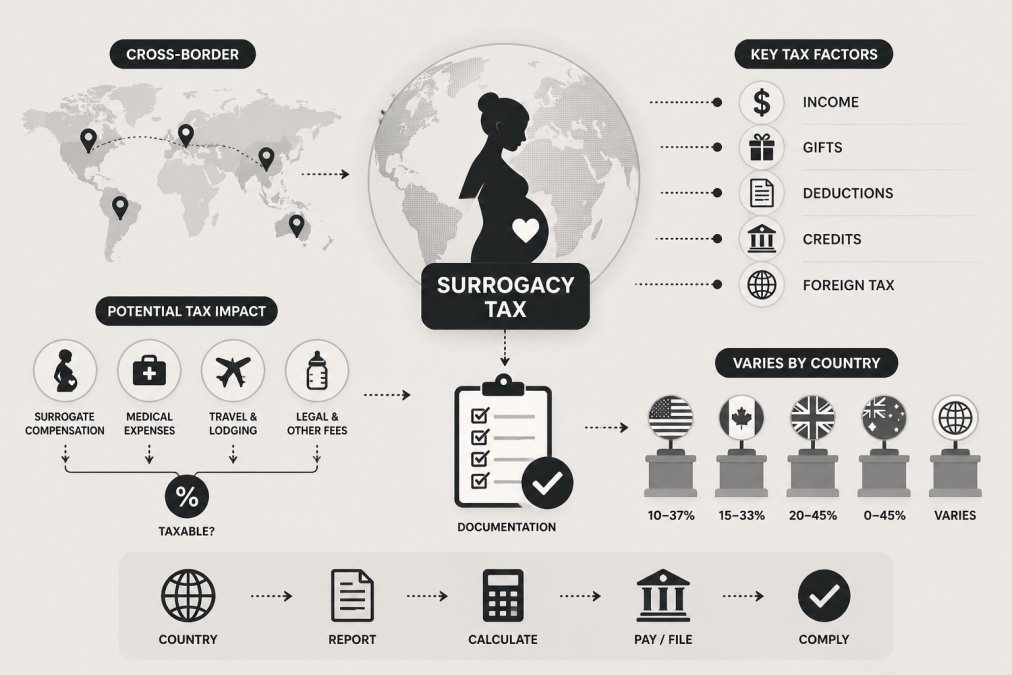
International surrogacy tax implications begin with one question the IRS asks before any other: is this money compensation, or is it reimbursement? The distinction shapes what you report, what you can deduct, and how much audit exposure you carry. This guide from Herman Family Group walks through each stage so you can plan with clear expectations.
The IRS treats payments to a gestational surrogate outside the United States differently from domestic arrangements, largely because the agency has not issued comprehensive published guidance on cross-border assisted reproductive technology. That gap puts the burden of accurate characterization on you as the Intended Parent.
Reimbursement is money paid to restore an expense the surrogate already incurred, such as prenatal care, travel, or insurance premiums. Compensation is payment for the surrogate’s time, discomfort, and risk, and it is generally treated as taxable income to her.
Reimbursement vs. Compensation: Why the Distinction Matters
Reimbursement is generally not income to the recipient because it restores a cost rather than creating a gain. Compensation is income, and the surrogate is responsible for reporting it.
What most guides miss is that the label on the contract does not control the tax outcome. The substance of the payment does.
- Track receipts for every reimbursed expense, matched to the payment
- Separate base compensation from expense reimbursements in your records
- Keep the legal contract language consistent with how funds actually move
Lumping reimbursements and compensation into a single wire transfer is a common mistake. It makes the two nearly impossible to separate later if the IRS asks questions.
IRS Medical Expense Deduction for Surrogacy: What Intended Parents Need to Know
The IRS medical expense deduction for surrogacy lets qualifying Intended Parents include certain fertility, pregnancy, and birth-related costs in their itemized medical deductions. It is not a dollar-for-dollar credit: it only reduces taxable income by qualified medical expenses exceeding a set percentage of your adjusted gross income (AGI), and only if you itemize.
Which Surrogacy Costs Typically Qualify
Qualified medical expenses generally include costs paid for the diagnosis, cure, mitigation, treatment, or prevention of disease, and for treatments affecting any structure or function of the body. In a surrogacy context, that commonly includes:
- Fertility treatment and medications for the Intended Parents
- Prenatal care and monitoring for the surrogate
- Hospital and delivery costs for the birth
- Lab work, imaging, and genetic testing tied to the treatment
- Certain travel costs primarily for and essential to receiving medical care
The Itemization Trade-Off
Because the medical expense deduction is an itemized deduction, it only helps if your total itemized deductions, medical, state and local taxes, mortgage interest, charitable contributions, and others, exceed the standard deduction for your filing status. For many Intended Parents, medical expenses are large enough to push them over that line in the birth year; in other years, they may not be.
If your expenses are split across two tax years, ask your tax professional whether accelerating or deferring a payment, where the contract and medical timeline allow, could concentrate qualified costs into one year. Do not move money solely for tax reasons without confirming the legal and contractual consequences first.
Documentation the IRS Expects
To support a medical expense deduction, you generally need the provider’s name, the amount paid, the date of payment, and a description of the service sufficient to show it was medical care. Keep explanation-of-benefits statements, itemized invoices, and proof of payment; a canceled check or wire confirmation alone may not show what the payment was for.
Surrogacy Tax Deduction Eligibility: Who Qualifies and How to Claim It
Surrogacy tax deduction eligibility depends on three things: whether the expense is a qualified medical cost, whether you itemize, and whether your total medical spending clears the income threshold. Intended Parents who claim the child as a dependent may also access related credits, though rules vary.
To claim the deduction:
- Confirm each expense meets the definition of medical care
- Total your qualified medical expenses for the tax year
- Compare that total against the applicable percentage of your adjusted gross income
- Itemize on Schedule A and retain documentation for every expense claimed
Income Thresholds and the Medical Expense Deduction
The medical expense deduction only applies to costs above a set percentage of adjusted gross income, and that percentage is adjusted periodically. Rather than rely on a figure from an older guide, check the current threshold directly with the IRS instructions for Schedule A before you estimate your deduction. Higher earners clear the threshold less often, which is why many Intended Parents see little or no benefit.
Reporting Foreign Fertility Expenses to the IRS
Reporting foreign fertility expenses to the IRS is where many Intended Parents lose track. Foreign payments still need to be documented, and in some cases disclosed, even when they were made to providers outside the country.
- Keep contracts, invoices, and wire confirmations for every foreign payment
- Note the exchange rate used on the date of each payment
- Store records for the full retention period in case of later review
Federal vs. State Tax Treatment of International Surrogacy
Federal and state treatment of international surrogacy expenses do not always align. A cost that qualifies as a medical expense federally may be treated differently by your state tax authority, and some states offer no medical expense deduction at all.
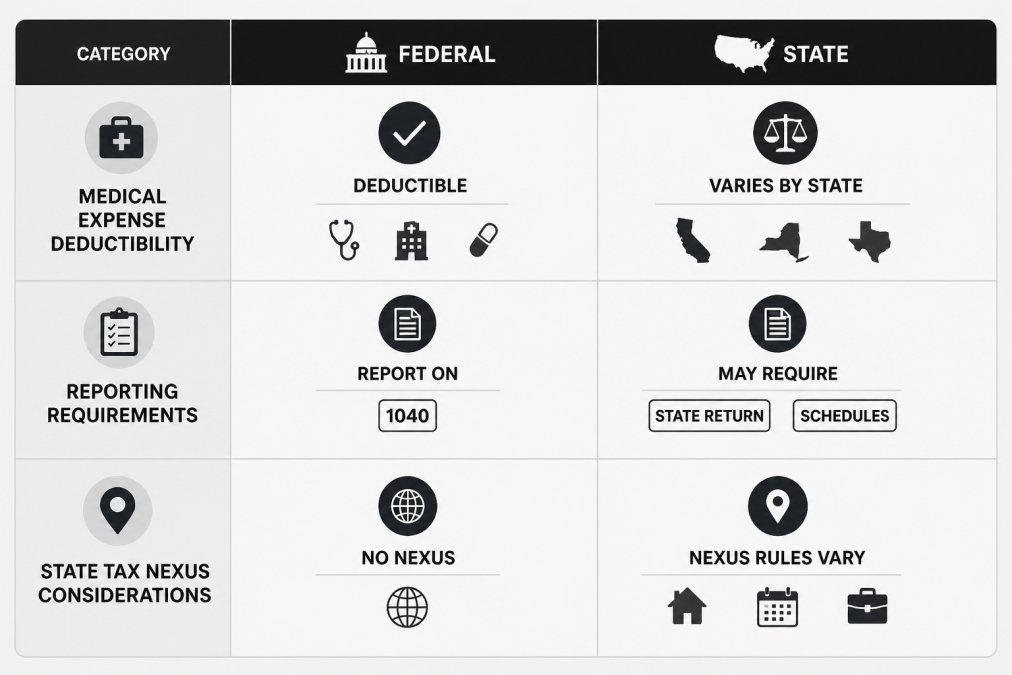
If you split time between two states, your tax residency status can change which state’s rules apply. Document where you actually reside during the tax year, not just where you own property.
Cross-Border Tax Treaty Implications and Double Taxation Risks
Most guides on international surrogacy taxes stop at the border. This section goes further, because the treaty layer is where Intended Parents with foreign income, foreign accounts, or foreign-based providers can encounter unexpected complexities.
How Characterization Drives the Treaty Outcome
Here is where the reimbursement-versus-compensation distinction returns, and it matters more in a cross-border arrangement than a domestic one. If a payment is characterized as compensation to the surrogate, treaty rules may allocate taxing rights to the country where the services are performed. If the same payment is characterized as a reimbursement of a documented expense, the analysis changes, because reimbursement is generally not income to the recipient.
When Double Taxation Risk Is Highest
Double taxation risk is real for Intended Parents who:
- Earn income abroad while residing in the United States
- Hold foreign financial accounts used to move funds to providers
- Pay foreign providers from a foreign-source account
- Have a tax residency position that is split between two countries
In each case, the same funds can be exposed to tax in two jurisdictions unless a treaty, a foreign tax credit, or a residency determination resolves the overlap. The IRS guidance on foreign tax credits explains how the credit works and which taxes qualify.
A treaty does not automatically relieve double taxation. You generally have to claim the relief on the correct form and support it with documentation of your residency position and the foreign tax paid. Assuming the treaty “takes care of it” is a common mistake.
The Residency Question Underlies Everything
Treaty benefits usually depend on where you are a resident for tax purposes. Most treaties contain tie-breaker rules for individuals who appear to be residents of both countries, looking at factors such as permanent home, center of vital interests, habitual abode, and nationality. Document where you actually live, work, and hold your primary ties during the tax year, not just where you own property.
Treaty relief is not automatic and not universal. Confirm whether a treaty is in force, confirm your residency position, and confirm how each payment is characterized before you file. The paperwork you build at the contract stage is what makes the treaty position defensible later.
Documentation and Record-Keeping for Surrogacy Tax Purposes
- Signed legal contract with the surrogate and any agency
- Itemized invoices for every medical and travel expense
- Proof of payment for each transfer, with dates
- Exchange rate records for foreign currency payments
- Copies of any foreign account statements used to move funds
- Correspondence with your tax professional on treatment decisions
The strongest protection against an audit challenge is a clean paper trail that ties every dollar to a documented purpose. Build it as you go, not after the fact.
Waiting until filing season to reconstruct the year is a common mistake. By then, wire confirmations and small receipts are often lost, and the deduction becomes difficult to support.
Conclusion
Sorting out surrogacy tax treatment across two countries is genuinely complex, and the rules shift as the IRS updates its guidance. The Intended Parents who manage it best plan the tax side before the first payment, not after the birth.
Frequently Asked Questions
Are medical expenses for international surrogacy tax-deductible for Intended Parents?
Qualified medical expenses paid for international surrogacy may be deductible if they exceed a percentage of your adjusted gross income. The IRS medical expense deduction for surrogacy generally covers fertility treatments, prenatal care, and delivery costs, but you must itemize deductions and meet the income threshold. Keep detailed records of all payments and consult a tax professional familiar with Assisted Reproductive Technology to confirm which expenses qualify for your situation.
Do I need to report international surrogacy expenses to the IRS?
Yes, if you are claiming the medical expense deduction or if you paid compensation to a surrogate. Reporting foreign fertility expenses involves documenting payments made to foreign clinics, agencies, and surrogates. Consult a tax advisor to ensure compliance with IRS guidelines on cross-border ART arrangements.
How does the IRS classify surrogacy-related payments for Intended Parents?
The IRS does not have a single classification for surrogacy payments. Medical expenses paid to clinics and hospitals are treated as qualified medical expenses. Compensation paid to a surrogate may be considered a personal expense rather than a deductible medical cost. Reimbursements for the surrogate’s out-of-pocket expenses like travel and lodging may also qualify as medical expenses if directly related to the ART procedures. Proper documentation and legal counsel are essential to support your tax filing position.
What tax forms are required for international surrogacy arrangements?
Intended Parents typically file Form 1040 and Schedule A to claim the medical expense deduction. For foreign surrogacy, you may need to report foreign bank accounts using FBAR if aggregate balances exceed the threshold. Consult a tax professional to determine your specific filing obligations.