Table of Contents
- Understanding the Cost of International Surrogacy in 2026
- International Surrogacy Programs in Ukraine: Legal Framework and Costs
- Surrogacy Cost in Czech Republic: What Intended Parents Should Know
- Legal Aspects of International Surrogacy: Impact on Overall Costs
Last Updated: July 28, 2026
Understanding the Cost of International Surrogacy in 2026
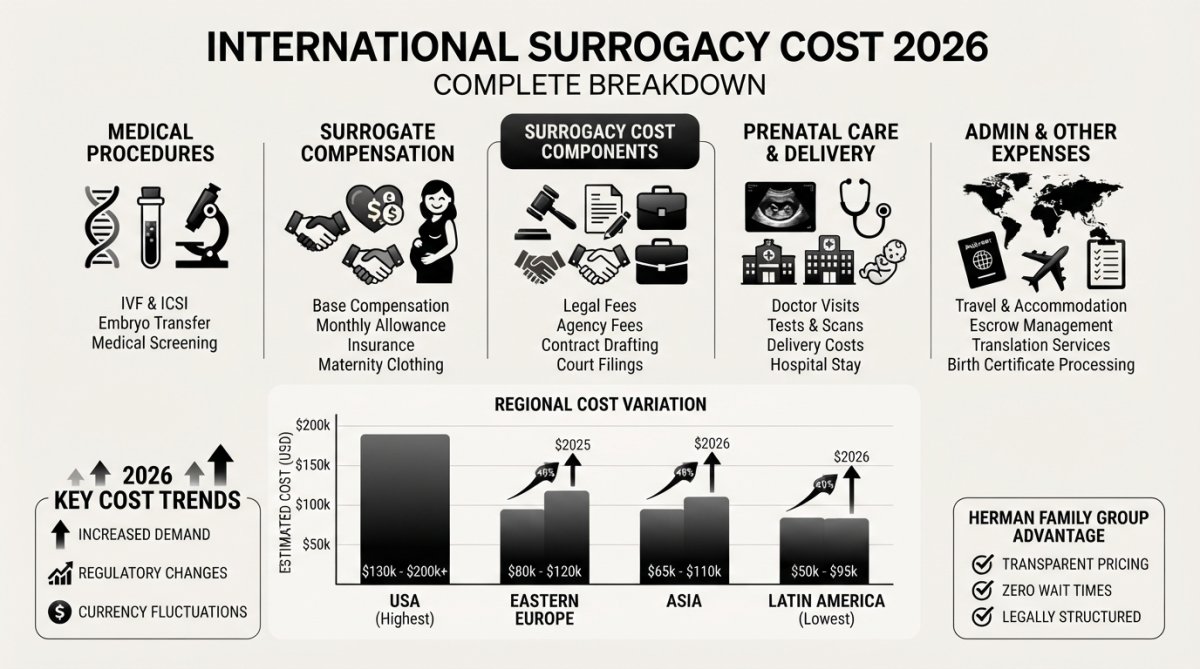
International surrogacy costs vary significantly by country, program structure, and medical needs. At Herman Family Group, we help Intended Parents understand the complete financial picture: medical procedures, legal documentation, agency fees, and travel expenses.
The cost of international surrogacy 2026 depends heavily on program location. Ukraine, Czech Republic, Mexico, and Armenia each offer different legal frameworks, medical standards, and fee structures.
International Surrogacy Programs in Ukraine: Legal Framework and Costs
Ukraine maintains one of the most legally structured international surrogacy frameworks globally. The legal system recognizes Intended Parents as the child’s biological parents from the moment of embryo transfer, eliminating post-birth custody complications.
Ukrainian surrogacy programs focus on married heterosexual couples and require Intended Parents to be at least 18 years old. Medical costs reflect high-quality fertility clinic standards with lower operational expenses than Western European programs. Surrogate compensation follows established market rates with regular payments throughout pregnancy and final payments upon successful birth and legal documentation completion.
Legal fees involve Ukrainian family court proceedings and notarization for establishing pre-birth orders and securing birth certificates. Post-birth order processing, citizenship documentation, and passport issuance extend beyond initial surrogacy agreement costs.
Surrogacy Cost in Czech Republic: What Intended Parents Should Know
Czech Republic offers a legally progressive surrogacy framework that accommodates diverse family structures, including single Intended Parents and LGBTQ+ couples. This legal inclusivity typically results in higher program costs compared to Ukraine.
Medical screening and IVF procedures involve detailed reproductive assessment, hormone protocols, and embryo development monitoring. Clinics provide transparent reporting on fertilization rates, embryo quality, and transfer readiness. Surrogate compensation follows regulated guidelines ensuring fair payment while maintaining ethical standards, with comprehensive health insurance coverage and psychological support throughout pregnancy.
Legal costs involve establishing parentage through civil court proceedings. For single Intended Parents or same-sex couples, additional legal documentation ensures full parental recognition across all jurisdictions.
Legal Aspects of International Surrogacy: Impact on Overall Costs
Legal complexity represents one of the most significant cost drivers in international surrogacy. The cost of international surrogacy 2026 includes multiple legal phases extending from contract drafting through citizenship processing and passport issuance.
Pre-birth order establishment requires specialized family law counsel familiar with both the surrogacy country’s legal system and the Intended Parents’ home country’s recognition of foreign parentage. Citizenship and passport processing represents a distinct legal phase that many Intended Parents delay until after birth, creating unnecessary post-birth stress.
Surrogacy contracts should specify responsibility for additional medical costs if complications require extended hospitalization, NICU care, or surgical intervention. Escrow account management ensures sufficient funds remain available for contingency medical expenses.
Comparing International Surrogacy Program Costs: Ukraine, Czech Republic, Mexico, and Armenia
Direct cost comparison across international surrogacy programs requires understanding both absolute costs and what each program includes. The following table summarizes typical cost components across Herman Family Group’s four program locations:
Program Component | Ukraine | Czech Republic | Mexico | Armenia |
|---|---|---|---|---|
Medical & IVF Procedures | Lower range | Higher range | Mid-range | Lower range |
Surrogate Compensation | Mid-range | Higher range | Mid-range | Lower range |
Agency Management Fees | Transparent, itemized | Transparent, itemized | Transparent, itemized | Transparent, itemized |
Legal & Parentage | Mid-range | Higher range | Mid-range | Lower range |
Travel & Accommodation | Lower cost | Mid-range | Lower cost | Lower cost |
Total Program Cost | Most economical | Most comprehensive | Balanced option | Most affordable |
Czech Republic programs: Single Intended Parents, LGBTQ+ couples, and those prioritizing inclusive legal frameworks with comprehensive support services.
Mexico programs: Intended Parents balancing cost considerations with geographic proximity to North America and established medical infrastructure.
Armenia programs: Intended Parents seeking affordable programs with solid legal frameworks and developing medical capacity.
Medical Costs and IVF-Inclusive Programs
Medical expenses represent the largest single component of international surrogacy costs, encompassing fertility assessment, hormone stimulation, egg retrieval, embryo development, and embryo transfer procedures.
Fertility clinic costs vary based on the complexity of medical protocols required for each Intended Parents’ specific situation. Medical screening for both Intended Parents and surrogates involves comprehensive health assessment, infectious disease testing, and psychological evaluation. Donor egg programs increase medical costs compared to cycles using the Intended Parent’s own eggs, but often provide higher success rates for Intended Parents with diminished ovarian reserve or genetic concerns.
NICU coverage and medical complication provisions should be explicitly addressed in program costs before program commencement.
Currency Fluctuation and Exchange Rate Risk in International Surrogacy
Currency fluctuation represents an often-overlooked financial risk in international surrogacy programs. Exchange rate movements can increase total costs depending on currency pairs and payment timing.
Intended Parents should understand which program costs are paid in local currency and which are paid in their home country currency. Medical and surrogate compensation are typically paid in the surrogacy country’s currency, while international legal counsel and travel may be paid in the Intended Parent’s home country currency.
Unexpected Costs and Financial Contingency Planning
Beyond standard program cost components, Intended Parents should budget for unexpected expenses that frequently arise during international surrogacy. Medical complications during pregnancy can increase total medical costs significantly. Extended travel requirements arise when Intended Parents must travel for initial consultations, medical monitoring appointments, embryo transfer procedures, or post-birth legal proceedings.
Additional legal proceedings sometimes become necessary if citizenship complications arise or if international custody recognition requires additional court filings. Maintaining communication with international legal counsel throughout the surrogacy process identifies emerging legal needs before they become expensive crises.
How Herman Family Group Supports Transparent Financial Planning
Herman Family Group provides Intended Parents with comprehensive cost transparency and financial planning support throughout the surrogacy journey. Our programs in Ukraine, Czech Republic, Mexico, and Armenia are structured with itemized pricing that clearly identifies medical costs, surrogate compensation, legal fees, agency management, and travel requirements.
Building your family through international surrogacy requires understanding the complete financial picture before committing to a program. Herman Family Group provides transparent pricing, comprehensive cost documentation, and personalized financial planning that helps Intended Parents make informed decisions with confidence. Our experienced team coordinates all program components, medical, legal, and logistical, ensuring you understand exactly where your investment is directed and what support you’ll receive from initial planning through birth and beyond. Create My Plan today to receive a detailed cost breakdown customized to your specific situation and family goals.
Frequently Asked Questions
What factors influence the cost of international surrogacy in 2026?
International surrogacy costs depend on program location, surrogate compensation standards, medical and IVF procedures, legal fees, agency management, and travel expenses. Each country—Ukraine, Czech Republic, Mexico, and Armenia—has different regulatory frameworks and pricing structures. Additional factors include whether you use a fresh or frozen embryo, donor egg requirements, health insurance coverage for surrogates, and whether you need pre-birth or post-birth legal orders. Currency fluctuation and exchange rates also impact final costs for Intended Parents paying in US dollars.
Are there different cost structures for international surrogacy programs Ukraine, Czech Republic, Mexico, and Armenia?
Yes, each country has distinct cost structures. Ukraine offers programs for married couples with established legal frameworks for parentage and birth certificate issuance. Czech Republic provides accessible programs with transparent pricing and established fertility clinics. Mexico offers options with varying legal complexity depending on state regulations. Armenia has emerging programs with different fee structures. All four destinations have different surrogate compensation levels, medical facility costs, legal requirements, and agency management fees. Intended Parents should evaluate each program's all-inclusive offerings versus itemized costs.
What is typically included in the overall cost of an international surrogacy program?
Comprehensive surrogacy programs typically include surrogate compensation, medical screening and psychological evaluation, IVF procedures and embryo transfer, fertility clinic fees, agency management and coordination, legal counsel and contract preparation, health insurance for the gestational carrier, and post-birth support until the birth certificate is issued. Some programs include travel expenses, accommodation, and translation services. However, coverage varies significantly by program. It's essential to request detailed breakdowns from agencies to understand what's included in quoted fees and what constitutes additional expenses.
How do legal and administrative fees impact international surrogacy costs?
Legal fees represent a substantial portion of international surrogacy costs. They cover surrogacy contract drafting, parental rights establishment, pre-birth or post-birth order processing, and citizenship documentation. Each country has different legal requirements—Ukraine requires specific procedures for birth certificate issuance, Czech Republic has established legal pathways, and Mexico's laws vary by state. Additionally, Intended Parents may need lawyers in their home country to recognize the child's citizenship and process passports. Currency conversion, escrow account management, and regulatory compliance add to administrative expenses.
What hidden costs should Intended Parents watch for in international surrogacy?
Hidden costs can include travel and accommodation beyond initial trips, medical complications requiring additional treatment, NICU care if the infant requires extended hospital stay, visa extensions or immigration delays, translation and notarization services, and post-birth travel for document processing. Currency fluctuation can increase expenses if payments span months. Some programs charge separately for psychological counseling, surrogate replacement if a cycle fails, or additional legal filings. Intended Parents should request itemized cost breakdowns, ask about escrow account transparency, and clarify what happens if complications arise during pregnancy or after birth.
How can Intended Parents budget effectively for international surrogacy costs?
Start by requesting detailed cost breakdowns from multiple programs covering medical, legal, agency, and surrogate compensation expenses. Build in a contingency fund for medical complications, currency fluctuations, and unexpected legal requirements. Consider payment timeline options—many programs offer installment schedules tied to program milestones. Factor in travel costs, time away from work, and post-birth expenses like citizenship processing and passport applications. Review escrow account terms to ensure transparent fund management. Consult with a financial advisor familiar with international surrogacy to understand tax implications and plan accordingly.
What role does escrow account management play in international surrogacy financing?
Escrow accounts protect both Intended Parents and surrogates by holding funds in a neutral third-party account. Payments are released according to the surrogacy contract timeline—typically at program start, after medical screening, following embryo transfer, at birth, and upon completion of legal processes. Transparent escrow management ensures funds are used as agreed and reduces financial risk. Intended Parents should verify that the escrow provider is independent, licensed, and follows established protocols. Clear escrow documentation protects against unauthorized withdrawals and ensures accountability throughout the surrogacy journey.
This article was written using GrandRanker