Table of Contents
- Understanding Global Surrogacy Services for Intended Parents
- International Surrogacy Laws by Country
- Surrogacy Legal Requirements for Intended Parents
- Cost of Surrogacy Abroad and Affordability
- Choosing a Reputable Surrogacy Agency
- Post-Birth Repatriation and Citizenship Logistics
- Ethical Considerations and Surrogate Rights
- Your Path Forward with Global Surrogacy Services
Global Surrogacy Services for Intended Parents: A 2026 Guide
Last Updated: July 15, 2026
Navigating global surrogacy services requires understanding legal frameworks, medical infrastructure, and realistic expectations across borders. This guide distills essential knowledge for informed decision-making about international surrogacy.
Understanding Global Surrogacy Services for Intended Parents
Global surrogacy operates across a spectrum of legal and medical frameworks. The fundamental distinction lies between commercial surrogacy (where the surrogate receives compensation beyond medical expenses) and altruistic surrogacy (where compensation is restricted to medical and reasonable living costs).
A gestational carrier receives an embryo created from the intended parents’ genetic material through IVF. This is distinct from traditional surrogacy, where the surrogate provides the egg herself, creating genetic ties that complicate legal parentage and is increasingly rare internationally.
Top-tier IVF clinics in Ukraine, Georgia, and Mexico offer success rates comparable to US facilities, with fresh embryo transfer success rates ranging from 50-65% for women under 35. Vetting requires specific questions: How many cycles does the clinic perform annually? What are their live birth rates (not just pregnancy rates)? Do they have international accreditation?
Success rates published by clinics often cite pregnancy rates, not live birth rates. Always request live birth rates per embryo transfer, this is the metric that matters for your family planning.
Commercial vs. Altruistic Surrogacy Models
Commercial surrogacy permits direct financial compensation to the surrogate beyond medical expenses, typically ranging from modest payments to substantial sums depending on the country. Altruistic surrogacy restricts compensation to medical costs and reasonable living expenses.
Commercial surrogacy dominates Ukraine, Georgia, Mexico, and parts of India, where legal frameworks explicitly permit and regulate surrogate compensation. These jurisdictions have mature medical tourism infrastructure and transparent fee structures.
Altruistic surrogacy exists primarily in Canada, the UK, Australia, and New Zealand. These programs are far more restrictive, often requiring proof of infertility, residency requirements, and lengthy waiting periods. Single parents, same-sex couples, and those without local residency face barriers.
Your choice between commercial and altruistic surrogacy determines which countries are viable. Altruistic surrogacy offers philosophical alignment but longer timelines and tighter eligibility. Commercial surrogacy provides more destination options and faster program start times.
Gestational Carriers and Embryo Transfer
A gestational carrier undergoes rigorous screening: medical history review, infectious disease testing, psychological evaluation, and uterine imaging. The surrogate’s own genetic material is not involved; the embryo comes from the intended parents’ gametes or donors.
The embryo transfer procedure is straightforward: a catheter places the embryo into the uterus under ultrasound guidance, taking minutes without anesthesia. The surrogate then follows a progesterone support protocol for 10-12 weeks.
Success depends on embryo quality, uterine receptivity, and the surrogate’s age and health. Younger surrogates (under 35) have higher success rates. A single embryo transfer has roughly a 50-65% live birth rate in top clinics, assuming genetic normalcy. Multiple transfers may be needed if the first cycle doesn’t result in pregnancy.
International Surrogacy Laws by Country
Surrogacy law is fragmented globally, with each country setting its own rules about legality, commercial arrangements, and parental rights recognition. Understanding your destination country’s legal status is non-negotiable.
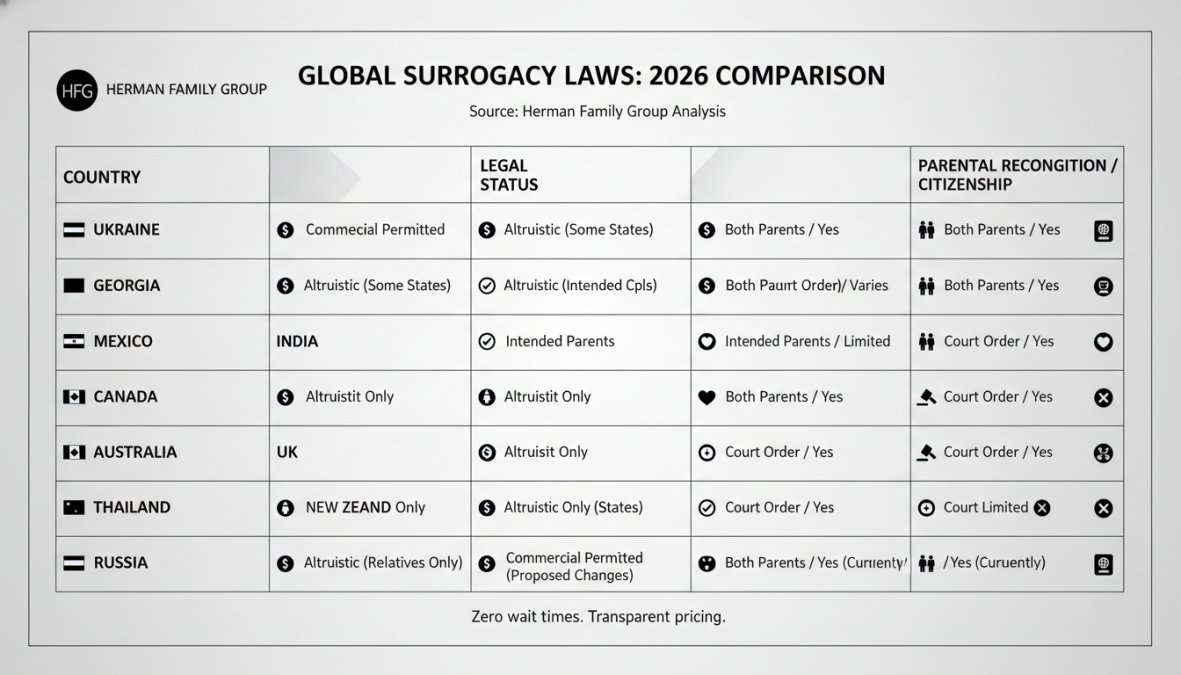
Ukraine permits commercial surrogacy with a well-established legal framework. Intended parents are registered as legal parents on the birth certificate at delivery, and the surrogate has no parental rights. The process is transparent and mature, though some countries (notably Germany and France) restrict recognition of Ukrainian surrogacies.
Georgia has emerged as a leading destination with clear commercial surrogacy laws, transparent costs, and excellent medical facilities. Like Ukraine, intended parents are granted legal parentage at birth.
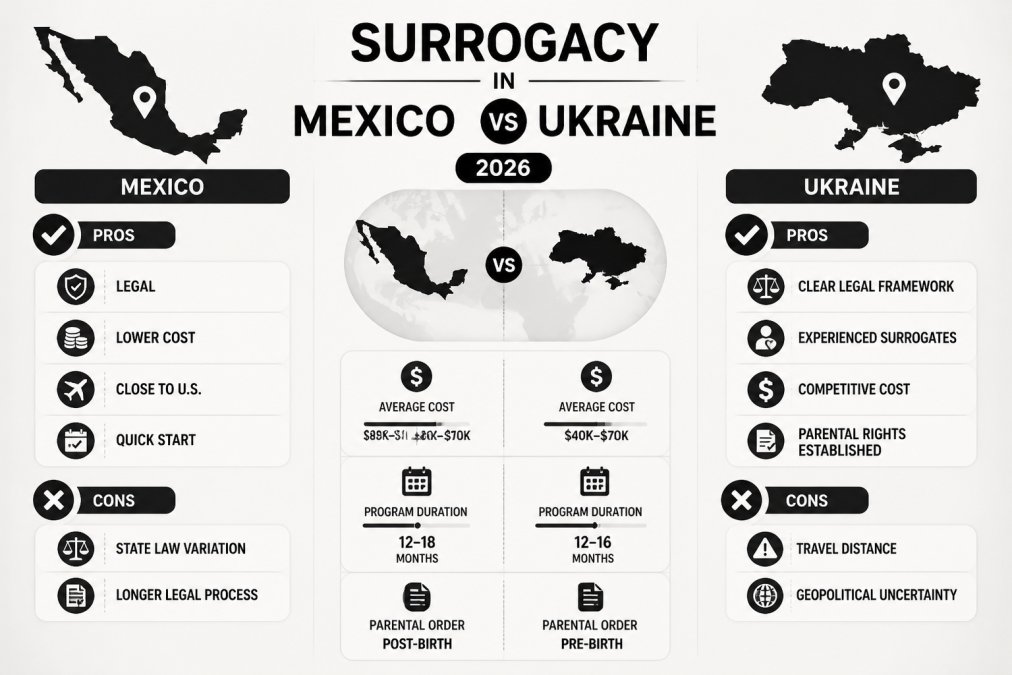
Mexico permits commercial surrogacy in some states (Tabasco, Coahuila, Sinaloa) but restricts it in others. Medical quality is high, but legal certainty is lower than Ukraine or Georgia.
India has increasingly restricted commercial surrogacy through regulation. Current law permits only altruistic surrogacy for specific categories of intended parents, and many international programs have closed.
Canada, UK, Australia, and New Zealand permit altruistic surrogacy only. Intended parents must meet strict eligibility criteria, often including proof of infertility and residency requirements. Waiting periods are measured in years. However, legal certainty for intended parents is extremely high once approved.
Some countries (Germany, France, Italy, Spain) do not recognize surrogacies conducted abroad. If you’re a resident of these nations, verify that your home country will recognize the child’s legal parentage before committing to a surrogacy program.
Legal Framework and Regulatory Environment
The regulatory environment determines how much legal protection intended parents receive and what happens if disputes arise. Strong regulatory environments like Ukraine and Georgia have established legal codes, government oversight of agencies, and clear dispute resolution mechanisms.
A strong legal framework includes statutory law defining surrogacy arrangements, agency licensing requirements, surrogate screening and consent protocols, and mechanisms for granting parental rights to intended parents. Well-regulated markets have agencies publishing detailed fee breakdowns; less-regulated markets have hidden costs and surprise fees.
Birth Certificate and Citizenship Processes
Obtaining a birth certificate naming you as the legal parent is the critical legal outcome of surrogacy. In some countries, this happens automatically at delivery. In others, it requires court orders or administrative procedures.
Automatic parentage at birth occurs in Ukraine, Georgia, and several other commercial surrogacy destinations. Intended parents are named on the birth certificate without additional legal proceedings.
Post-birth legal proceedings are required in some jurisdictions. A court must issue a parentage order recognizing the intended parents as legal parents. This adds time and cost but is still relatively straightforward in countries with established surrogacy frameworks.
Citizenship of the child depends on birthplace and intended parents’ citizenship. A child born to a Ukrainian surrogate may be a Ukrainian citizen at birth, requiring you to obtain citizenship in your home country through naturalization or derivative citizenship processes. The repatriation process typically takes 2-4 weeks.
Surrogacy Legal Requirements for Intended Parents
Eligibility to pursue international surrogacy varies by destination country and program. Unlike domestic surrogacy in some jurisdictions, international surrogacy has fewer universal requirements. However, reputable agencies screen intended parents carefully.
Common eligibility criteria include age (typically 21-55), legal capacity to enter contracts, and demonstrated ability to care for a child. Few programs require proof of infertility, which is a major advantage for single parents and same-sex couples.
Financial capacity is scrutinized carefully. Agencies need assurance that intended parents can pay the full program cost upfront or through a verified payment plan. Documentation typically includes proof of identity, marriage certificate (if applicable), and financial statements.
LGBTQ+ Legal Considerations and Parental Rights
Same-sex couples and LGBTQ+ individuals face legal complexity in surrogacy that heterosexual couples often avoid. The core issue: many countries do not automatically recognize same-sex couples as legal parents, even if the surrogacy itself is legal.
For same-sex male couples, surrogacy is often the only path to biological parenthood. One or both partners provide sperm; a donor egg is used; and a surrogate carries the pregnancy. The legal question is whether both partners will be recognized as legal parents. In countries like Ukraine and Georgia, both partners can be named on the birth certificate if the country of intended parentage recognizes same-sex partnerships. In countries that don’t, only one partner may be recognized as the legal parent, requiring post-birth adoption by the second partner.
For same-sex female couples, one partner can provide an egg and the other can carry the pregnancy (reciprocal IVF), or both can use donor eggs with a surrogate.
For single LGBTQ+ individuals, surrogacy is legally straightforward in most commercial surrogacy destinations. However, home country recognition may be complicated if the country restricts surrogacy for unmarried individuals.
Work with a family law attorney in your home country before starting a surrogacy program. They can advise whether your jurisdiction will recognize the birth certificate issued by the surrogacy destination.
Cost of Surrogacy Abroad and Affordability
The cost of international surrogacy varies dramatically by destination country and program structure. Understanding the cost breakdown helps you compare programs fairly.
| Cost Component | Typical Range | Notes |
|---|---|---|
| Surrogate compensation | Varies by country | Commercial: $10K-$20K+; Altruistic: Medical costs only |
| IVF and medical procedures | $8K-$15K | Includes egg retrieval, embryo transfer, prenatal care, delivery |
| Agency fees | $5K-$15K | Covers matching, coordination, support |
| Legal fees | $3K-$10K | Birth certificate, parentage orders, repatriation documents |
| Travel and accommodation | $3K-$8K | Flights, hotels for key appointments |
| Insurance and contingency | $2K-$5K | Medical emergency coverage, travel insurance |
Total program costs range from approximately $35K-$70K+ depending on destination and complexity. Ukraine and Georgia tend toward the lower end.
The lowest-cost program isn’t always the best value. A cheap program with inexperienced staff or poor medical outcomes can become expensive quickly. Compare total costs across reputable programs rather than focusing on headline price.
Choosing a Reputable Surrogacy Agency
A reputable agency is your single most important partner in international surrogacy. The agency coordinates medical care, manages the surrogate relationship, handles legal documentation, and provides support throughout the journey.
Evaluate agencies on several dimensions: years of experience, number of successful cycles completed, surrogate screening protocols, medical partnerships, legal expertise, and client support. Ask for references from past clients and verify claims independently.
Experience matters. Agencies with 5+ years of operation and 100+ successful surrogacies have refined processes and learned how to handle complications.
Surrogate screening is critical. Reputable agencies conduct thorough medical and psychological evaluations before matching and verify that surrogates understand the commitment and are medically suitable for pregnancy.
Medical partnerships reveal quality. Agencies partnered with accredited IVF clinics experienced in high-volume surrogacy offer better success rates. Ask which clinics the agency works with and verify their credentials.
Legal expertise is non-negotiable. The agency should employ or partner with attorneys experienced in both the destination country’s surrogacy law and your home country’s family law.
Safety, Security, and Track Record
Safety in international surrogacy encompasses medical safety, legal safety, and financial security.
Medical safety depends on clinic accreditation, infection control protocols, and emergency response capabilities. Ask whether the clinic is accredited by international bodies (ASRM, ESHRE).
Legal safety means the agency operates transparently, uses written contracts, and ensures all parties understand their rights and obligations. Verify that contracts are reviewed by attorneys in both the destination country and your home country.
Financial security requires that the agency hold funds in escrow, provide detailed invoices, and have clear refund policies. Verify their financial stability.
Track record is demonstrated through client testimonials, published success rates, and verifiable outcomes. Request live birth rates (not just pregnancy rates) and ask about complications and how they were handled.
Medical Infrastructure and IVF Success Rates
The quality of medical infrastructure directly affects your success rates and safety. Top surrogacy destinations invest heavily in fertility clinics that rival US facilities.
IVF success rates vary by clinic, patient age, and embryo quality. For women under 35 using their own eggs, live birth rates per embryo transfer range from 50-65% in top clinics. For women over 40, rates decline to 20-40%.
However, published success rates can be misleading. Some clinics report pregnancy rates (which are higher than live birth rates). Always request live birth rates per embryo transfer.
Medical facilities in top surrogacy destinations include modern operating rooms, advanced ultrasound equipment, and embryology laboratories. Doctor expertise is critical. Reproductive endocrinologists should be board-certified and have published research. Ask about the specific doctor managing your cycle and their credentials.
Post-Birth Repatriation and Citizenship Logistics
Repatriation, bringing your child home, is often overlooked but is critical for a smooth transition. The process involves obtaining travel documents, navigating immigration requirements, and establishing legal parentage in your home country.
Birth certificate is the foundation. Ensure it names you as the legal parent(s) and includes all required information.
Passport for the child in the birth country is typically required for international travel. This usually takes 1-3 weeks.
Visa or entry permit for your home country depends on your citizenship and the child’s citizenship status. Consult with an attorney about post-birth legal proceedings that may be necessary.
Exit visa permits the child to leave the birth country. In many surrogacy destinations, the intended parents (as named on the birth certificate) can typically obtain an exit visa directly. Clarify this with your agency before birth.
Insurance and Medical Emergency Coverage
Medical emergencies during surrogacy can be costly. Ensure you have adequate coverage for both the surrogate and the child.
Surrogate medical insurance is typically provided by the agency or clinic. Confirm that it covers pregnancy complications, emergency delivery, and post-delivery care.
Your insurance as the intended parent may not cover surrogacy-related costs. Check your policy carefully. Some plans explicitly exclude surrogacy; others cover specific components.
Evacuation insurance is advisable if traveling to a country with less-developed medical infrastructure. Cost is typically $300-$1,000 for a pregnancy term.
Newborn coverage is critical. Ensure the child is covered from birth and that coverage extends to the birth country and during travel home.
Ethical Considerations and Surrogate Rights
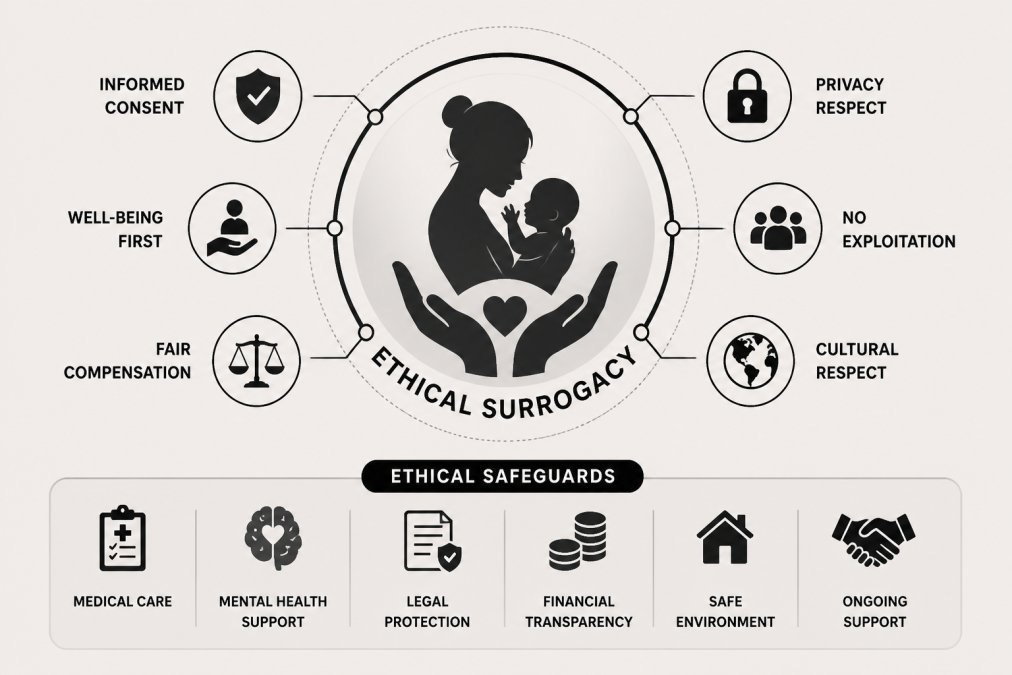
International surrogacy raises ethical questions about surrogate welfare, exploitation, and rights that deserve serious consideration.
Surrogate welfare is the primary ethical concern. In well-regulated destinations, surrogates are screened for coercion, paid fairly, and provided medical care. In less-regulated destinations, surrogates may face economic desperation, inadequate compensation, or poor medical support.
Informed consent means the surrogate fully understands the physical, emotional, and legal implications of carrying a pregnancy for others. She should have independent legal counsel and time to consider before committing.
Exploitation risk is real in surrogacy. Economic desperation can drive women into arrangements they wouldn’t otherwise choose. Ethical surrogacy requires that surrogates have genuine alternatives and aren’t coerced by poverty.
Ethical surrogacy requires that you view the surrogate as a partner in your family-building journey, not a service provider. This mindset drives better outcomes for everyone involved.
Your Path Forward with Global Surrogacy Services
Global surrogacy services have become increasingly sophisticated and accessible, but success requires careful planning, reputable partners, and realistic expectations.
Start by clarifying your values and constraints. Are you comfortable with commercial surrogacy, or do you prefer altruistic arrangements? Which countries align with your legal, ethical, and financial situation? What timeline works for your family?
Research potential agencies thoroughly. Request references, verify credentials, and ask detailed questions about processes, outcomes, and support. Consult with a family law attorney in your home country to advise whether your jurisdiction will recognize the child’s legal parentage from your chosen surrogacy destination.
Herman Family Group specializes in legally structured international surrogacy, offering zero wait times for program commencement, transparent pricing with no hidden fees, and comprehensive medical and emotional support from initial planning through birth and beyond. With over a decade of experience, Herman Family Group has built partnerships with accredited medical clinics and legal professionals in legally sound surrogacy destinations, ensuring your journey is safe, ethical, and successful.
Begin your surrogacy journey with confidence. The path to parenthood through international surrogacy is challenging but deeply rewarding for those who pursue it thoughtfully.
Frequently Asked Questions
What are the safest countries for international surrogacy?
Safety depends on legal framework stability, medical infrastructure quality, and regulatory oversight. Countries with established surrogacy laws, accredited IVF clinics, and transparent surrogacy agreements typically offer greater security. Research the legal status of surrogacy in your target country, verify clinic credentials, and work with experienced surrogacy agencies that specialize in cross-border surrogacy in legally structured destinations. Always consult international legal counsel familiar with both your home country and destination country laws.
How much does global surrogacy cost for Intended Parents?
Cost of surrogacy abroad varies significantly by country, clinic, and program structure. Factors include medical procedures, surrogate compensation, agency fees, legal documentation, travel, and insurance. Pricing depends on your specific circumstances, location, and chosen services. Visit surrogacy agency websites for transparent pricing breakdowns, and request detailed cost estimates that itemize all fees to avoid hidden costs and understand total affordability for your family-building journey.
What legal challenges do Intended Parents face in global surrogacy?
Common legal hurdles include navigating different surrogacy laws across countries, securing parental rights recognition, obtaining birth certificates, and managing exit visas for the newborn. LGBTQ+ Intended Parents may face additional restrictions in certain jurisdictions. Legal counsel specializing in international surrogacy law is essential to address these challenges. Surrogacy agreements must clearly establish legal parentage, and repatriation logistics require careful coordination with both the destination country and your home country authorities.
How do I choose a reputable international surrogacy agency?
Evaluate agencies based on experience, track record, transparency in pricing and processes, legal expertise, medical partnerships, and support for diverse family structures. Check credentials, read client testimonials, verify clinic accreditations, and confirm they specialize in cross-border surrogacy in legally sound destinations. Ask about their screening process for surrogates, medical success rates, and comprehensive support from initial planning through birth and beyond. Ensure they offer no-hidden-fee pricing and personalized plans for your situation.
Is international surrogacy legal for all Intended Parents?
Legal eligibility depends on your home country's laws and the destination country's regulations. Some countries restrict surrogacy to married heterosexual couples, while others permit single parents and LGBTQ+ couples. Your marital status, sexual orientation, and citizenship affect your options. Research the legal framework in both your home country and potential destination countries. Work with surrogacy agencies experienced in supporting diverse family structures to identify legally viable pathways for your specific circumstances and ensure parental rights protection.
Building your family through global surrogacy services for intended parents is possible when you have the right guidance and partners. The complexity of international law, medical coordination, and emotional support demands expertise and compassion. Herman Family Group provides both, helping intended parents navigate every step with transparency, legal certainty, and unwavering support. Create My Plan today and take the first step toward the family you’ve imagined.
This article was written using GrandRanker