Table of Contents
- Understanding the Emotional Landscape of International Surrogacy
- Distance, Uncertainty, and the Loss of Control
- Coping Strategies for Intended Parents
- Managing Expectations in Surrogacy
- Surrogacy Support Groups for Intended Parents
- The Grief of the International Surrogacy Journey
- Conclusion
- Frequently Asked Questions
Last Updated: September 13, 2026
Understanding the Emotional Landscape of International Surrogacy
The emotional challenges of international surrogacy journeys begin long before any medical appointment. They start with the quiet question every Intended Parent asks themselves: what if something goes wrong, and I am thousands of miles away? This guide from Herman Family Group draws on more than a decade of supporting families through cross-border programs, and it treats those emotions as a real part of the process rather than a footnote.
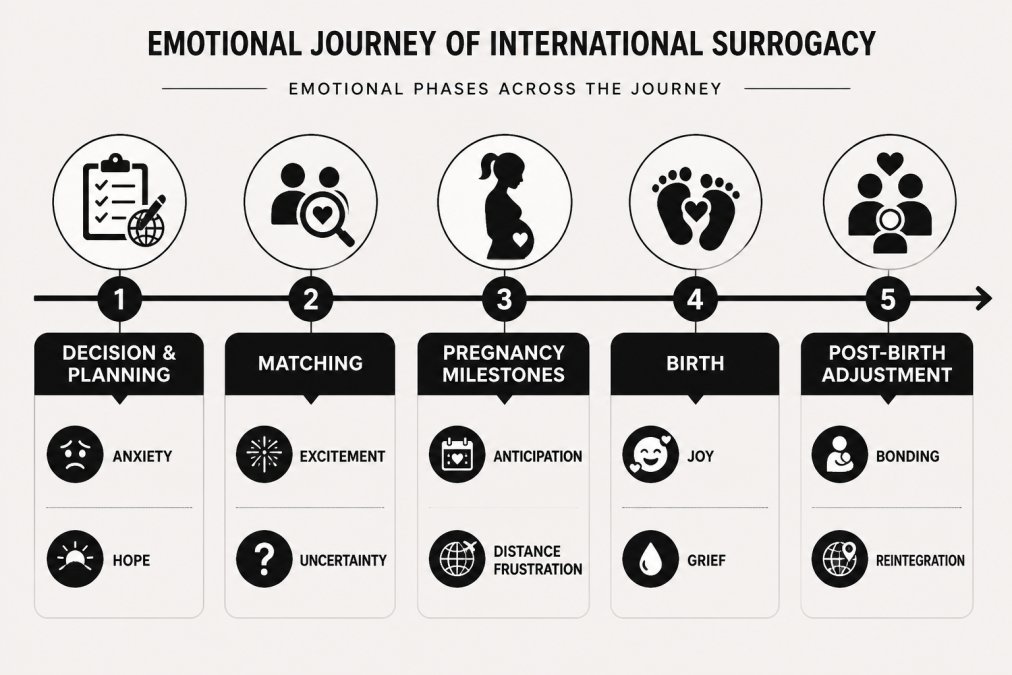
International surrogacy is a family-building arrangement in which Intended Parents living in one country work with a surrogate mother and clinic in another, usually because local law or wait times make a domestic path difficult or unavailable. The emotional landscape of that arrangement has its own shape: hope sits next to anxiety, and joy sits next to grief.
The timeline below shows how those phases typically unfold.
Distance, Uncertainty, and the Loss of Control
The hardest part of a long-distance journey is not the paperwork. It is the loss of control.
When your surrogate mother attends a scan you cannot attend, you are trusting a report, a photograph, and a coordinator’s summary. That gap between knowing and not knowing is where anxiety grows. Gestational surrogacy already asks Intended Parents to hand over the most personal process of their lives to other people. Distance multiplies that feeling.
There is also a legal framework you do not fully control. U.S. Department of State guidance on assisted reproductive technology and citizenship explains how citizenship questions are handled for children born abroad, and reading it before you commit is far less frightening than discovering it later. Uncertainty is manageable when it is named early.
Do not sign with any program that cannot explain, in writing, which country’s law governs your parental rights and how your child’s citizenship will be established. Vague answers here are the single most common source of later heartbreak.
Coping Strategies for Intended Parents
Coping strategies for Intended Parents work best when they are practical, not philosophical. Four habits consistently help:
- Set a fixed update schedule. Ask your coordinator for updates on set days rather than messaging constantly. Predictability lowers anxiety more than frequency does.
- Keep one person outside the process. A friend or therapist who is not emotionally invested in the outcome gives you somewhere to be honest.
- Write things down. A simple journal of questions and answers stops the same worry from circling.
- Plan small rituals. A weekly photo, a recorded heartbeat, a saved onesie. Tangible anchors help the fetus feel real across a geographical gap.
What most guides miss is that coping is not about feeling less. It is about feeling the same amount without it spilling into your marriage, your work, and your sleep.
Managing Expectations in Surrogacy
Managing expectations in surrogacy means accepting ranges instead of dates, and accepting that a cross-border pregnancy has more moving parts than most. The goal is not to lower your hopes. It is to build a plan that can survive contact with reality.
Expect the medical timeline to move. A due date is an estimate, not a promise. A due window of several weeks is normal even in an uncomplicated pregnancy, and travel planning should be built around that window rather than a single day. Ask your clinic and your program what their typical range looks like, and plan your leave, your flights, and your childcare around the outer edges of that range.
Expect at least one plan to change. A common pattern is that one element of the journey shifts, a transfer date, a travel document, a legal processing step, and the rest of the plan has to absorb it. Intended Parents who build slack into their schedule report far less frustration than those who fix on one date and one route.
Expect the legal process to have its own clock. Parental rights and citizenship questions are governed by rules that do not move on your schedule. U.S. Department of State guidance on assisted reproductive technology and citizenship explains how citizenship questions are handled for children born abroad, and reading it before you commit is far less frightening than discovering it later. Your program should be able to tell you, in writing, which country’s law governs your parental rights and how your child’s citizenship will be established.
Expect the emotional timeline to lag the medical one. Many Intended Parents find that the anxiety peaks not at transfer or birth, but in the quiet weeks after they return home. The pregnancy is over, the adrenaline is gone, and the reality of caring for a newborn in a new country, or back in your own, sets in. Planning for that period in advance, with the same care you gave to the pregnancy, is one of the most useful things you can do.
Expect your surrogate mother’s experience to be different from yours. She may bond with the baby during pregnancy in a way that is healthy and appropriate for her role, and she may also grieve after birth. Neither of those is a sign that something went wrong. It is a sign that she is a person, not a vessel. Programs that prepare Intended Parents for this, and that prepare surrogate mothers for their own post-birth emotions, produce far smoother journeys than programs that do not.
Ask your program for a written “what if” list before transfer: what happens if the surrogate mother needs bed rest, if travel documents are delayed, if the birth happens earlier than expected, or if either party needs emotional support after birth. Reading the answers while calm is very different from hearing them in a crisis.
| Common Expectation | Realistic Version | Why It Matters |
|---|---|---|
| Fixed due date | A due window of several weeks | Travel and leave planning stay flexible |
| Constant updates | Scheduled updates plus urgent alerts | Protects your mental health and your surrogate mother’s privacy |
| One predictable timeline | A timeline with at least one change built in | Prevents mid-process surprises |
| Immediate bonding | Bonding that builds over weeks | Reduces guilt after birth |
| Surrogate mother moves on quickly | She may need her own recovery time | Protects her well-being and yours |
A note on the return home. The reintegration period, the first weeks and months after you bring your baby home, is where expectations are most often tested. Friends and family may assume the hard part is over. In many ways, it is just beginning. Build a support plan for that period before you travel, not after you land.
Surrogacy Support Groups for Intended Parents
Surrogacy support groups for Intended Parents are not a sign of weakness. They are the fastest way to stop feeling like the only person doing this.
Options include moderated online communities, agency-run peer circles, and one-to-one counseling with a therapist who understands third-party reproduction. The American Society for Reproductive Medicine patient resources publishes patient-facing material that helps you ask better questions of any group you join.
Look for a group with Intended Parents at your stage, not just at the start. Someone three months ahead of you is more useful than someone three years behind.
The Grief of the International Surrogacy Journey
Grief is the emotion nobody warns you about, and it is real. It is also not one thing. In cross-border journeys, Intended Parents and surrogate mothers tend to carry different griefs at the same time, and naming them separately is what makes them manageable.
The grief of the pregnancy you did not carry. You will not feel the first flutter, you will not be the one who knows the baby’s sleep rhythms before birth, and you may meet your child for the first time in a room you have never seen before. That is a real loss, and it sits alongside your joy rather than canceling it out.
The grief of the milestones you watched on a screen. Ultrasound images, a recorded heartbeat, a coordinator’s summary, these are gifts, but they are also reminders of the distance. Many Intended Parents describe a strange double feeling at each milestone: gratitude and a quiet ache in the same moment.
The grief of the version of parenthood you imagined. Some Intended Parents grew up expecting a certain story, a partner’s pregnancy, a hospital down the street, family in the waiting room. Letting go of that story is part of the work, and it is not disloyal to the family you are building to admit it.
The surrogate mother’s grief, which is separate and deserves its own space. A surrogate mother who carries a child for someone else and then hands that child to his or her parents is not simply “done” at birth. Most practitioners find that the days and weeks after delivery are the most emotionally complex part of her journey. She may feel relief, pride, and a deep, disorienting emptiness, sometimes all at once. Her body has changed, her hormones are shifting, and the person she was caring for is now in another country. Programs that treat the birth as the finish line for her are not treating her fairly.
This is where the surrogate’s post-partum mental health becomes a real, practical concern rather than a footnote. A surrogate mother can experience post-partum depression, anxiety, or a prolonged grief response even when the pregnancy was planned, wanted, and joyful for everyone involved. The risk is higher when she has limited contact with the Intended Parents after birth, when she feels her role has been minimized, or when she has no one in her own life who understands what she did. Good programs build in a post-birth check-in schedule for her, not just a final payment, and connect her with a counselor who understands third-party reproduction. If you are an Intended Parent, asking your program what support your surrogate mother receives after birth is not intrusive. It is one of the most important questions you can ask.
Cultural mediation and language barriers add another layer. When you and your surrogate mother do not share a first language, small misunderstandings can feel enormous. A delayed reply can read as coldness. A direct question can read as distrust. A joke can land wrong. A good program provides professional interpretation and a coordinator who explains context, not just words, someone who can tell you that a certain phrase is polite in her culture, or that a certain silence is respectful rather than upsetting. If you are learning each other’s languages, keep it simple and kind. Written messages translated by an app are better than nothing, but they are not a substitute for a human mediator when the topic is emotional.
The reintegration and bonding period after you return home deserves the same attention as the pregnancy itself. Many Intended Parents describe the first weeks at home as the moment the journey actually becomes theirs, and also as the moment the emotions they held together abroad start to surface. You may feel exhausted, relieved, and unexpectedly sad. Your surrogate mother may be grieving in a different time zone. Your family and friends may not understand why you are not simply overjoyed. All of that is normal, and all of it is easier when you have planned for it in advance.
If you are struggling, Postpartum Support International help and resources offers support lines and local referrals for new parents, including those who did not carry. Surrogate mothers can use the same resources, and many programs also maintain their own counselor lists.
The emotional work of international surrogacy does not end at birth. Plan for support during the first six months at home, and ask what support your surrogate mother receives after delivery, both matter more than most guides admit.
Conclusion
The emotional challenges of international surrogacy journeys are not a sign that something is wrong. They are the predictable cost of building a family across borders, and they are far easier to carry with the right structure around you.
Herman Family Group was built for exactly this. Our programs start immediately with zero wait times, our pricing is transparent with no hidden fees, and our team provides medical and emotional support from initial planning through birth and beyond, including personalized plans for single parents and couples. We work only in legally structured destinations, so your parental rights are addressed before they are tested.
Create My Plan with Herman Family Group and start your journey with a team that stays with you until you are home.
Frequently Asked Questions
How can Intended Parents manage the stress of international surrogacy?
Start by building a structured support system before the journey begins. This includes a mental health professional familiar with third-party reproduction, a peer support group, and clear communication routines with your surrogate. Break the process into manageable phases and set realistic expectations for each one. Physical distance can amplify anxiety, so schedule regular video calls and ask your agency for consistent milestone updates. If stress becomes overwhelming, seek counseling rather than pushing through alone.
What are the common emotional milestones in a surrogacy journey?
Most Intended Parents move through recognizable phases. Early planning often brings hope mixed with anxiety about legal and medical unknowns. Matching typically triggers excitement and doubt about compatibility. Pregnancy milestones, like ultrasounds and the first heartbeat, create connection but also highlight the geographical gap. Birth brings intense joy and, for some, unexpected grief over the surrogate’s role ending. The adjustment period after returning home involves bonding, identity shifts, and reintegration into daily life.
How does distance impact the emotional connection with a surrogate?
Physical distance can make Intended Parents feel like observers rather than participants. Missed appointments, time zone differences, and language barriers can intensify frustration and anxiety. To counter this, establish a reliable communication schedule, ask your surrogate how she prefers to share updates, and use video calls for milestone moments. Many Intended Parents find that sending small gifts or recording voice messages helps maintain a sense of presence despite the miles.
What support systems are available for Intended Parents during international surrogacy?
Support comes in several forms. Professional counseling with a therapist who understands third-party reproduction is essential. Peer-led surrogacy support groups for Intended Parents offer lived-experience advice and reduce isolation. Your agency should provide emotional support and care coordination from planning through birth and beyond. Online communities and faith-based or LGBTQ+ family-building networks can also help. If you are single or in a same-sex couple, look for groups that specifically address your family structure.