Table of Contents
- Why Vetting International Surrogacy Lawyers Matters
- Questions to Ask Surrogacy Lawyers in the First Consultation
- Your Surrogacy Attorney Consultation Checklist
- Cross-Border Surrogacy Legal Risks to Screen For
- Red Flags in Legal Representation and Conflict of Interest Disclosures
- Cost Transparency and Fee Structures for Surrogacy Attorneys
- How to Vet International Surrogacy Lawyers: A Step-by-Step Process
- Frequently Asked Questions
Last Updated: September 12, 2026
Why Vetting International Surrogacy Lawyers Matters
Choosing the right legal partner is the single most consequential decision in a cross-border surrogacy journey, and it is the one most Intended Parents rush. This guide from Herman Family Group explains how to vet international surrogacy lawyers so you can protect your family before you sign anything.
Surrogacy law varies dramatically by jurisdiction. A contract that is fully enforceable in one country may be unenforceable, or even illegal, in another. That gap is where families get hurt: disputed parentage, delayed citizenship for the child, or months stranded abroad waiting on paperwork. Vetting legal counsel is not a formality. It is the foundation of your child’s legal status.
Most guides on this topic are written by law firms selling their own services. This one is a buyer’s guide. We will show you the questions that separate experienced cross-border counsel from generalists, the red flags that signal trouble, and the cost structures that hide fees until it is too late to walk away.
The quality of your legal representation determines whether your child’s parentage and citizenship are secure. Vet the lawyer before you commit to the program, not after.
Questions to Ask Surrogacy Lawyers in the First Consultation
The best way to vet international surrogacy lawyers is to ask direct, specific questions and listen for specific answers. Vague reassurance is a warning sign. Concrete detail is a good sign.
Ask these questions in your first consultation:
- Are you licensed to practice in the jurisdiction where the surrogacy will take place, and in good standing?
- How many cross-border surrogacy cases have you handled, and in which countries?
- Who prepares the surrogacy agreement, and is it enforceable where the Intended Parents live?
- How will you establish parental rights, and what is the timeline for a parental order or equivalent?
- What is your process for securing the child’s citizenship and passport?
- Do you have local counsel on the ground, or do you coordinate with one?
- What are your total fees, and what is not included?
- What happens if the arrangement breaks down or the birth mother changes her mind?
A qualified fertility attorney answers these without hesitation. A generalist deflects.
Licensing and Cross-Border Experience
Licensing and cross-border experience are the two credentials that matter most. A lawyer who handles domestic family law may be excellent at home and still be the wrong choice for an international surrogacy arrangement.
Cross-border cases involve immigration law, consular processing, foreign statutory requirements, and the laws of more than one country at once (travel.state.gov). Ask for the specific jurisdictions where the attorney has completed cases, not just studied the law. Experience in one country does not transfer automatically to another.
Your Surrogacy Attorney Consultation Checklist
Most ranking pages hand you a list of questions and stop there. A list is not a vetting tool, it is a starting point. What follows is a weighted scorecard you can actually use to compare two or three attorneys side by side, because the goal is not to find a lawyer who answers every question. It is to find the one whose answers hold up under scrutiny.
Score each attorney from 0 to 3 on every line, where 0 is “no answer or refused,” 1 is “vague reassurance,” 2 is “specific but unverified,” and 3 is “specific, documented, and offered in writing.” A perfect score is 30. In practice, most experienced cross-border counsel land in the 22-27 range; anything below 18 is a signal to keep looking.
| # | Vetting Criterion | What a 3 Looks Like | Weight |
|---|---|---|---|
| 1 | License and bar standing in the relevant jurisdiction | Names the bar, offers a verification path, confirms good standing | High |
| 2 | Completed cross-border cases by country | Names specific jurisdictions and approximate case counts | High |
| 3 | Parentage establishment mechanism | Explains the specific order or route used in your destination | High |
| 4 | Citizenship and passport process | Walks through each step, names the agency involved, gives a realistic timeline | High |
| 5 | Local counsel on the ground | Identifies the firm or attorney and their role | High |
| 6 | Written fee structure with inclusions and exclusions | Provides a document, not a verbal estimate | High |
| 7 | Conflict of interest disclosure | Discloses in writing who pays them and any agency or clinic ties | High |
| 8 | References from prior international cases | Offers contactable references, not testimonials | Medium |
| 9 | Contingency planning | Describes what happens if the arrangement breaks down | High |
| 10 | Written terms before retainer | Puts scope, fees, and responsibilities in writing before payment | High |
A few notes on how to use this. First, weight the high-priority rows more heavily when you tally, a 3 on references does not offset a 0 on conflict disclosure. Second, do not score during the call. Take notes, then score afterward, when you are not being charmed. Third, ask each attorney the same questions in the same order so the scores are comparable.
Ask each attorney to send their answers in writing after the consultation. Attorneys who will not put their answers in writing are telling you something important about how they will communicate once you have paid a retainer.
If an attorney scores below 18, or refuses to be scored at all, that is your answer. Keep looking. The right counsel will welcome the scrutiny, it is a sign you are a serious client.
Cross-Border Surrogacy Legal Risks to Screen For
Cross-border surrogacy legal risks fall into a handful of predictable categories, and a good attorney will name them before you ask. Screening for these risks is the core of due diligence.
The main risks include:
- Parentage recognition: Some jurisdictions do not recognize Intended Parents as legal parents at birth, requiring a court order (peer-reviewed research).
- Enforceability: A surrogacy contract valid in the destination may not be enforceable at home.
- Citizenship and immigration: The child may need specific documentation before travel, and consular processing can take time.
- Statutory requirements: Some countries require genetic links, marriage, or residency that may not apply to you.
- Legal guardianship gaps: Between birth and a final order, there may be a window where your legal status is unclear.
Ask your attorney how each risk applies to your specific situation. Generic reassurance is not an answer.
Red Flags in Legal Representation and Conflict of Interest Disclosures
Red flags in legal representation usually appear early, and they are easy to miss when you are emotionally invested. Watch for them.
Warning signs include:
- No written fee agreement, or fees described only verbally
- Refusal to disclose whether the attorney is paid by the agency or clinic
- No local counsel in the surrogacy destination
- Promises of guaranteed outcomes, which no ethical attorney can make
- Pressure to sign before you have reviewed the contract
- Vague answers about parentage, citizenship, or timelines
Conflict of interest disclosures deserve special attention. If your attorney is also retained by the agency, the clinic, or the birth mother, their loyalty may be divided (americanbar.org). Ask directly who pays them and whether any party other than you has a financial interest in the arrangement. A trustworthy attorney answers this in writing.
An attorney who is paid by the agency rather than by you may not represent your interests first. Always ask who pays your lawyer, and get the answer in writing before you sign a retainer.
Cost Transparency and Fee Structures for Surrogacy Attorneys
No ranking page on this topic will tell you how to evaluate a lawyer’s billing model. That is the gap this section fills. Legal fees are only one line in a much larger surrogacy budget, and the structure of those fees tells you as much about an attorney as the amount does.
There are three common models in cross-border surrogacy work, and each carries a different risk profile for Intended Parents.
Flat fee for defined services. The attorney quotes a single amount for a defined scope, for example, contract drafting, or a parental order filing. This is the most predictable model and the easiest to budget against. The risk is scope creep: a flat fee that excludes court filing costs, translations, apostilles, or foreign counsel is not really flat. Ask what triggers an additional charge and get the answer in writing.
Hourly billing. The attorney bills for time spent. This is common for complex or contested matters, and it can be appropriate when the scope genuinely cannot be predicted. The risk is open-ended cost. Ask for a written estimate of hours by phase, a regular billing cadence, and a notification threshold, the point at which the attorney must check in before continuing to bill.
Retainer with supplemental charges. You pay an upfront retainer that draws down against hourly work, with separate charges for filings, local counsel, and third-party costs. This is the most common structure in cross-border work because it accommodates the unpredictability of foreign jurisdictions. The risk is that the retainer runs out mid-matter and you face an unexpected request for more funds at the worst possible moment.
Whichever model you are quoted, evaluate it against these questions:
- What is included, and what is explicitly excluded?
- Are government filing fees, translations, apostilles, and courier costs billed separately?
- Is local counsel in the surrogacy destination included or billed as a separate engagement?
- What happens if the matter takes longer than estimated?
- What is the refund or credit policy if the arrangement ends early?
- Are there charges for phone calls, emails, or administrative work?
| Fee Category | What It Typically Covers | What to Confirm in Writing |
|---|---|---|
| Initial consultation | Case review and strategy | Whether the fee is credited toward the retainer |
| Contract drafting | Surrogacy agreement preparation | Whether review by local counsel is included |
| Parental order filing | Court application for parentage | Whether court fees are separate |
| Citizenship support | Documentation and consular steps | Whether government fees are included |
| Local counsel | On-the-ground representation | Whether billed separately or bundled |
| Contingency work | Disputes or unexpected issues | Whether it is covered or billed hourly |
A practical rule: the more a fee structure depends on you not asking questions, the more you should ask. An attorney who provides a written breakdown, names the exclusions, and explains what triggers additional charges is demonstrating the same transparency you will need from them if something goes wrong mid-process.
A verbal fee estimate is not a fee agreement. Before you pay any retainer, ask for the scope, the inclusions, the exclusions, and the additional-charge triggers in writing. If the attorney will not provide that, treat it as a red flag.
For our own program pricing, see the pricing page on our website, which lists what is included with no hidden fees.
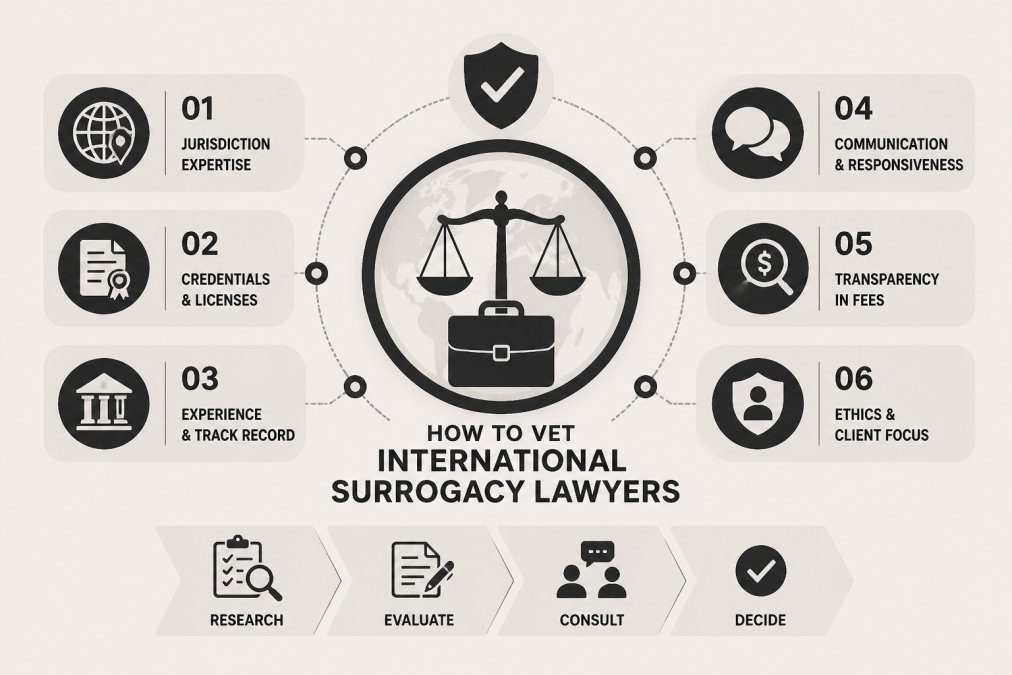
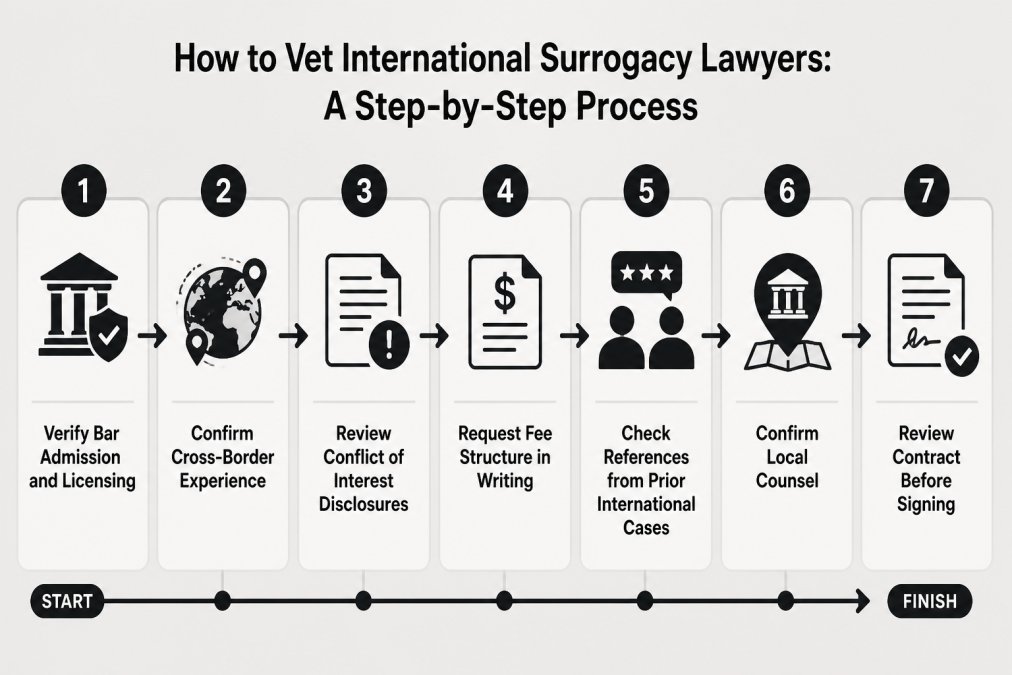
How to Vet International Surrogacy Lawyers: A Step-by-Step Process
Follow these steps in order. Each one filters out attorneys who are not equipped for cross-border work.
- Verify bar admission and licensing. Confirm the attorney is licensed and in good standing in the relevant jurisdiction.
- Confirm cross-border experience. Ask for specific countries and case counts, not general claims.
- Review conflict of interest disclosures. Get written confirmation of who pays the attorney and any competing loyalties.
- Request the fee structure in writing. Insist on inclusions, exclusions, and what triggers additional charges.
- Check references from prior international cases. Speak with Intended Parents who have completed the process with this attorney.
- Confirm local counsel on the ground. Verify who represents you in the surrogacy destination.
- Review the contract before signing. Never sign a surrogacy agreement you have not read with your own attorney’s guidance.
This process takes time, and that is the point. Rushing it is how families end up with unclear parentage or unexpected fees.
Vetting international surrogacy lawyers is hard, and doing it alone is harder. Herman Family Group coordinates legal, medical, and logistical support for Intended Parents worldwide, with transparent pricing and no hidden fees, zero wait times for program commencement, and full support from initial planning through birth and beyond. Our team specializes in cross-border surrogacy in legally structured destinations and builds personalized plans for diverse family structures, including single parents and couples. Get started with Herman Family Group and begin your journey with a plan built around your family.
Frequently Asked Questions
What specific legal credentials should I look for in an international surrogacy attorney?
Look for active bar admission in the jurisdiction where the arrangement will be executed, plus a documented track record with cross-border surrogacy cases. Ask whether the attorney has handled parental orders or citizenship acquisition for children born through assisted reproduction technology. Confirm they carry malpractice insurance and can name the specific countries where they have closed cases. A fertility attorney who only handles domestic matters may not understand the immigration law and consular processing steps your child will need.
What are the red flags to watch for when hiring a surrogacy attorney?
Red flags include refusing to disclose conflicts of interest, quoting fees only verbally without a written breakdown, claiming guaranteed outcomes, and having no verifiable references from international cases. Be cautious if the attorney cannot explain which jurisdiction governs the surrogacy contract or if they dismiss questions about cross-border legal risks. An attorney who pressures you to sign quickly or who will not put the fee structure in writing is a risk you should not take.
What questions should Intended Parents ask during an initial consultation with a surrogacy lawyer?
Ask how many international surrogacy arrangements the attorney has completed in the last three years, which countries they have worked in, and how they coordinate with local counsel abroad. Request a sample timeline for securing parental rights and a birth certificate. Ask who handles consular processing and what happens if the child’s legal status is challenged. Also ask for a written fee estimate and whether any costs are billed separately by foreign attorneys.
How does the legal process for international surrogacy differ from domestic arrangements?
International surrogacy involves at least two legal systems: the country where the surrogate gives birth and the country where you will bring the child. You may need a fertility attorney in each jurisdiction, plus immigration law guidance for citizenship acquisition. Parental orders, birth certificate amendments, and consular processing all cross borders, which adds time and cost. Domestic arrangements typically involve one state’s statutory requirements, while cross-border legalities require due diligence on enforceability in both countries.