Table of Contents
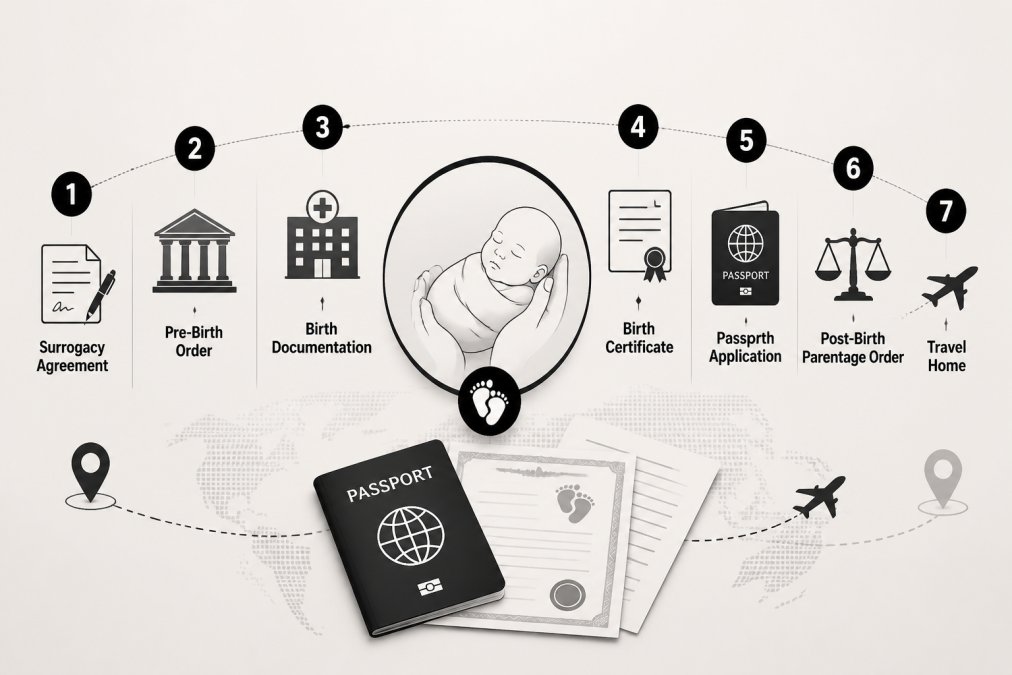
- Building Your Legal Roadmap Before Birth
- Pre-Birth Order Requirements: What Intended Parents Must File
- The Surrogacy Birth Certificate Process After Delivery
- Traveling With a Surrogate Baby: Legal Documentation You Need
- Citizenship, Passports, and Consular Processing for Your Baby
- Emergency Contingency Planning and Airport Security Checklist
- Post-Arrival Integration and Psychological Preparation
- Conclusion
- Frequently Asked Questions
Last Updated: September 10, 2026
Building Your Legal Roadmap Before Birth
Bringing a surrogate baby home starts long before the delivery room. The legal steps for bringing a surrogate baby home are a sequence of court filings, birth registration documents, and travel papers that must be prepared in the correct order, and families who begin planning after the birth often face delays that stretch into weeks or months.
This guide breaks down that sequence into practical stages, from your first pre-birth filing to the moment you walk through your front door with your child.
The single most important insight is this: legal parentage is not established by biology or by the birth itself. It is established by a court order, and in many cross-border situations, by paperwork that must be filed before your baby is born. Miss that window and you may need to adopt your own child.
Pre-Birth Order Requirements: What Intended Parents Must File
A pre-birth order is a court judgment, issued before delivery, that names the Intended Parents as the legal parents of the child and directs the hospital to list them on the birth certificate. Not every state recognizes pre-birth orders, and requirements vary by jurisdiction, so confirm the rules that apply to your surrogate’s location with a licensed attorney (peer-reviewed research).
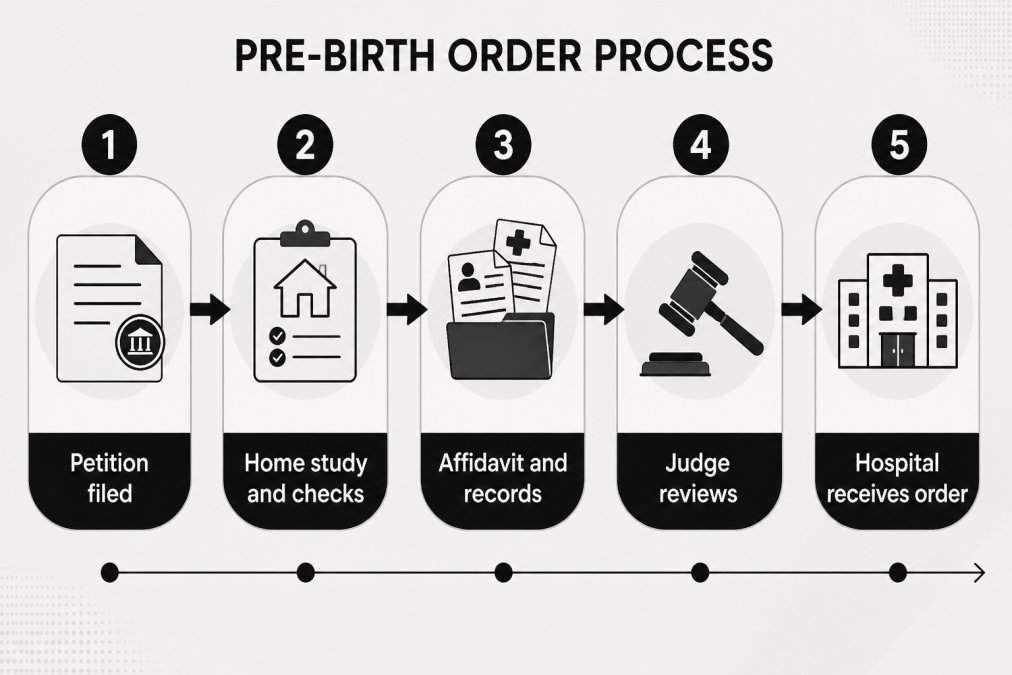
The typical filing sequence looks like this:
- Petition filed with the court, including your surrogacy agreement and medical documentation
- Home study and background checks completed where the court requires them
- Surrogate affidavit and medical records submitted
- Judge reviews the file and issues the order
- Hospital receives a certified copy of the order before birth
The Surrogacy Birth Certificate Process After Delivery
The surrogacy birth certificate process depends entirely on what your pre-birth order says. Where a judge has already named the Intended Parents, the hospital’s vital records office typically issues the birth certificate with the Intended Parents listed directly, and the surrogate’s name does not appear.
Where no pre-birth order exists, the surrogate is usually recorded as the legal mother at birth (the CDC). Correcting that record afterward requires a court judgment and a formal amendment through the state vital records agency, a process that can take considerably longer.
Two documents drive this stage:
- The hospital’s acknowledgment of parentage or court order presented at intake
- The completed birth registration worksheet, which the hospital submits to the state
Traveling With a Surrogate Baby: Legal Documentation You Need
Traveling with a surrogate baby is where the legal work you did before birth either holds up or falls apart. Border officers and airline agents are not evaluating your parenting, they are evaluating whether the adult in front of them has legal authority to move this particular infant across a border. Your job is to make that answer obvious in under a minute.
Three documents do most of the work, and each answers a different question:
- The child’s passport answers “may this child travel?” It is issued to the child, not to you, and it must be valid for the full period the destination requires.
- The court order or judgment naming you as legal parent answers “who is this child’s parent?” This is the document that replaces the birth certificate when the birth certificate is incomplete, amended, or issued in another jurisdiction.
- The notarized travel consent letter from the surrogate answers “does anyone with a competing claim object to this trip?” It matters most when the surrogate is not traveling with you.
What belongs in your carry-on legal binder
Build one binder and keep it with you, never in checked luggage:
- Certified copy of the child’s birth certificate
- Certified copy of the court order or judgment naming you as legal parent
- Notarized travel consent letter from the surrogate
- The child’s passport, plus a photocopy of the photo page
- The child’s medical records and vaccination documentation
- Contact details for your attorney and the nearest consulate
- A one-page cover sheet listing every document in the binder, in order
The cover sheet is the part most families skip and the part that saves the most time. When an officer asks for proof of parentage, you hand over one page instead of rifling through a folder.
Verify before you book
Entry and exit requirements differ between the jurisdiction where your child was born and the one you are returning to, and they change. Confirm current rules with the relevant consulate before you book flights, and ask specifically whether the destination requires a travel letter, a court order, or both. U.S. Department of State guidance on children and international travel
Citizenship, Passports, and Consular Processing for Your Baby
Citizenship by descent and passport issuance are separate processes, and each has its own evidence requirements. A Consular Report of Birth Abroad establishes the child’s citizenship status where the parents qualify to transmit it, while a passport is the travel document itself.
Consular processing generally requires the birth certificate, proof of the parents’ citizenship, evidence of the genetic or legal relationship where relevant, and completed application forms. Some posts request DNA testing to confirm a genetic relationship, particularly where documentation is incomplete or where local records are unreliable. DNA testing requirements vary by consulate, and testing must be arranged through approved laboratories.
For families where neither parent has a genetic link to the child, citizenship transmission can be more complex. Speak with an immigration attorney about your specific circumstances rather than relying on general guidance.
Emergency Contingency Planning and Airport Security Checklist
Most guides assume a smooth process. The families who get caught out are the ones who planned for the birth but not for the delay. Emergency contingency planning is the stage that determines whether a two-week trip becomes a two-month stay.
Decide who has authority before you need it
If you are delayed, by the surrogate’s recovery, by the baby’s health, by a passport that has not arrived, someone has to be able to make medical decisions for your child in your absence. Name a temporary legal guardian in writing, and confirm that the document is valid in the jurisdiction where your child is physically located. A guardianship that is valid at home may not be recognized where you are staying.
Plan for the two most common delays
A delayed passport. Passport processing times change, and an application that is pending when your return flight departs leaves you with a child who cannot leave. Before you travel, identify the nearest consulate or passport agency, confirm what expedited options exist, and know whether you can extend your stay without losing your job or your housing. Build a buffer into your return date rather than booking the earliest possible flight.
A legal dispute over parentage. This is rare where a pre-birth order was issued, but it is the scenario that turns a homecoming into a court case. If the surrogate or another party contests parentage, the court order naming you as legal parent is your anchor. Keep a certified copy with you at all times, keep your attorney’s direct line in your phone, and do not leave the jurisdiction with the child until your attorney confirms you may.
Confirm coverage from the moment of birth
Confirm in writing that your medical insurance covers the infant from birth, not from the date you add the child to the policy. A gap of even a few days can become a significant bill if the baby needs care. Ask your insurer for the effective date in writing and keep that letter in your binder.
Airport security checklist
- Passport valid for at least six months beyond your return date
- Certified birth certificate and court order in carry-on, not checked luggage
- Notarized travel consent letter if the surrogate is not traveling with you
- Infant medical records and vaccination documentation
- Written confirmation of the infant’s insurance effective date
- Contact details for your attorney and the nearest consulate
- Copies of all documents stored separately from the originals
Build the plan before the birth, not after
The time to decide who has authority, which consulate you would call, and how long you can afford to stay is before your child arrives. Write it down, share it with your attorney and your support network, and treat it as part of the legal roadmap rather than an afterthought.
Post-Arrival Integration and Psychological Preparation
The legal work ends at the border, but the transition does not. Post-arrival integration involves registering the birth with your local authorities, applying for any additional identity documents your country requires, and adding your child to health insurance and benefits.
Psychological preparation deserves the same attention. Many Intended Parents describe the period after arrival as unexpectedly difficult, a mix of relief, exhaustion, and grief for the surrogate relationship that has ended. This is common and not a sign that anything has gone wrong.
A few things help:
- Line up a pediatrician before you travel home
- Arrange a postnatal support network in advance, not after arrival
- Consider speaking with a counselor familiar with third-party reproduction
- Give yourselves permission to do nothing but bond for the first weeks
Families navigating cross-border surrogacy in legally structured destinations need coordination that continues until everyone is home.
Conclusion
The legal steps for bringing a surrogate baby home reward preparation over improvisation. Every document you file before birth reduces the risk of a custody dispute or a delayed return, and every contingency you plan for removes a decision you would otherwise make under pressure.
Herman Family Group supports Intended Parents through exactly this process, with transparent pricing and no hidden fees, zero wait times for program commencement, and full medical and emotional support from initial planning through birth and beyond. Our team specializes in cross-border surrogacy in legally structured destinations and designs personalized plans for single parents, same-sex couples, and diverse family structures.
Create My Plan with Herman Family Group and start your journey with the legal groundwork already in place.
Frequently Asked Questions
Can surrogates legally keep the baby?
A properly executed surrogacy agreement and a pre-birth order establish the Intended Parents’ legal parentage before birth, so the surrogate has no legal claim to the child. The agreement typically includes a parental rights waiver. If no pre-birth order is obtained, parentage may be determined after birth through a court judgment, which can delay the birth certificate and travel documents.
What legal documents are required to establish parentage after a surrogate birth?
You will need a signed surrogacy agreement, a pre-birth order or post-birth court judgment, a parental rights waiver from the surrogate (if applicable), and a birth certificate listing you as parents. For married couples, some states presume parentage; for unmarried or same-sex couples, a court order is often required. All documents should be notarized and, if international, apostilled or consularized.
How do Intended Parents secure citizenship for a baby born via surrogacy?
If at least one parent is a U.S. citizen, the baby may acquire citizenship by descent. You will apply for a Consular Report of Birth Abroad (CRSB) at a U.S. consulate or embassy. Required documents include the birth certificate, surrogacy agreement, pre-birth order, and proof of the parent’s citizenship and physical presence. Processing times vary, so apply early.
What legal steps are necessary when traveling across state lines with a surrogate baby?
Before traveling, ensure you have the birth certificate, pre-birth order, and any necessary court orders. Some states require a travel letter or consent from the surrogate. For international travel, check passport and visa requirements for the baby. Carry notarized copies of all legal documents and be prepared to present them at airport security.