Table of Contents
- Best Legal Destinations for International Surrogacy: Quick Comparison
- How We Evaluated These Destinations
- International Surrogacy Laws by Country: A Detailed Breakdown
- United States: Strongest Legal Protections
- Georgia: Progressive Laws, Affordable Costs
- Ukraine: Established Framework (Current Complexities)
- Mexico: Growing Accessibility for International Parents
- Colombia: Emerging Destination with Legal Clarity
- Greece and Albania: European Alternatives
- Armenia: Lower-Cost Option with Legal Recognition
- Cost of International Surrogacy: What to Expect by Destination
- Surrogacy for Gay Couples Abroad: Legal Eligibility by Country
- Ethical International Surrogacy: Ensuring Safe, Transparent Practices
- Tax, Insurance, and Repatriation: Often-Overlooked Legal Considerations
- Which Destination Is Right for Your Family?
Best Legal Destinations for International Surrogacy: 7 Countries Compared
Last Updated: July 16, 2026
When Intended Parents explore building their families through international surrogacy, the legal landscape becomes their most critical consideration. Finding the best legal destinations for international surrogacy requires understanding where the procedure is permitted, where Intended Parents receive genuine legal protection, where birth certificates are straightforward to obtain, and where the process respects both surrogacy-friendly laws and ethical standards. At Herman Family Group, we’ve tracked surrogacy regulations across multiple jurisdictions for over a decade, and the reality is stark: legal frameworks vary dramatically, and choosing the wrong destination can create years of paperwork complications or leave your parental rights unprotected.
This guide breaks down the best legal destinations for international surrogacy by examining seven countries that offer distinct advantages depending on your family structure, budget, and timeline.
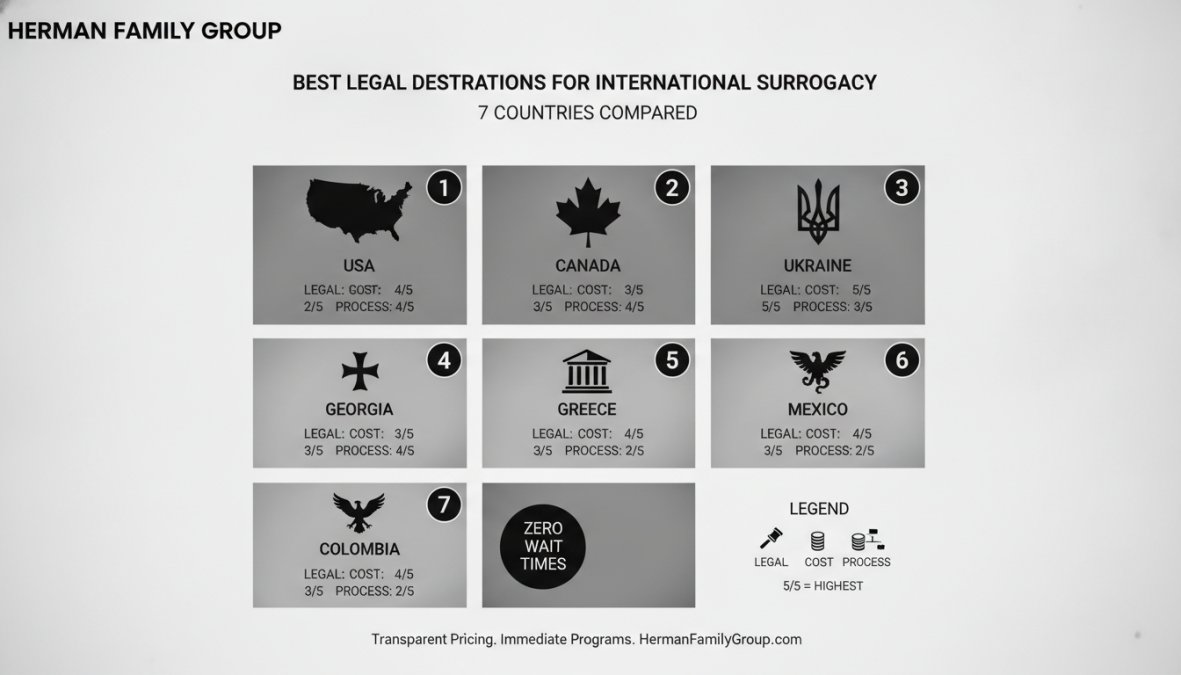
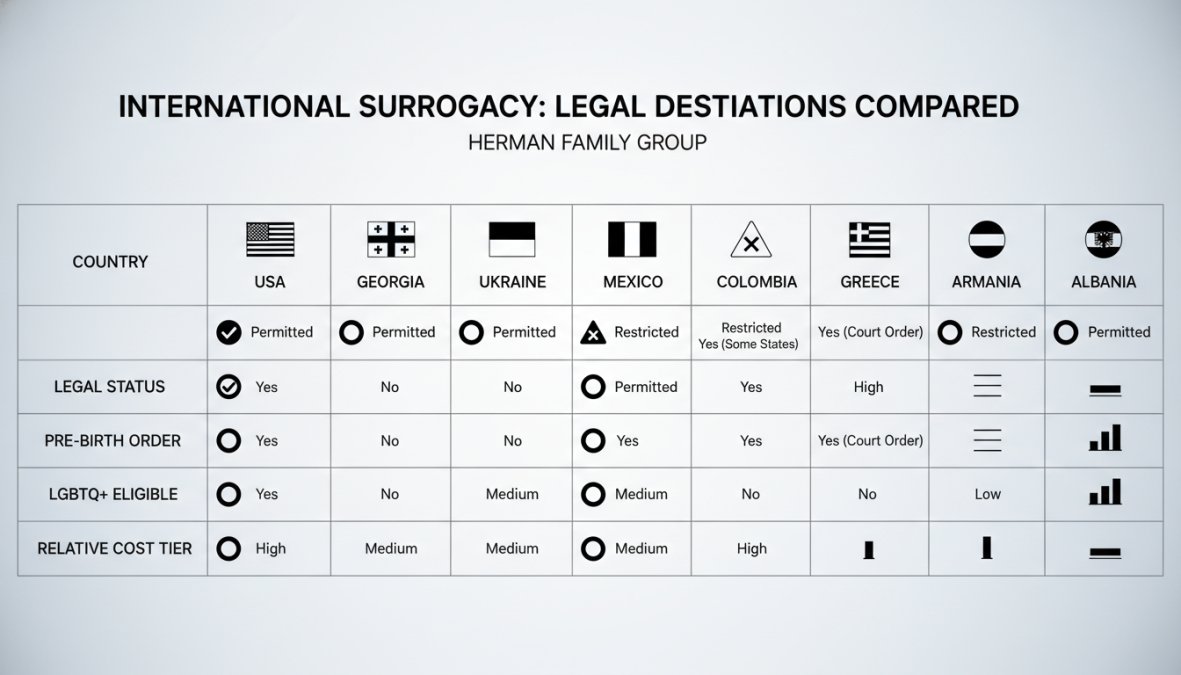
Best Legal Destinations for International Surrogacy: Quick Comparison
| Destination | Legal Status | Pre-Birth Order | LGBTQ+ Eligible | Estimated Cost Range | Timeline |
|---|---|---|---|---|---|
| United States | Permitted (state-dependent) | Yes (varies) | Yes | $150,000-$250,000 | 18-24 months |
| Georgia | Permitted (commercial) | Yes | Limited | $50,000-$70,000 | 12-16 months |
| Ukraine | Permitted (commercial) | Yes | Limited | $40,000-$65,000 | 12-18 months |
| Mexico | Permitted (varies by state) | Limited | Limited | $60,000-$100,000 | 14-20 months |
| Colombia | Permitted (commercial) | Yes | Limited | $55,000-$85,000 | 13-18 months |
| Greece | Permitted (altruistic only) | Limited | Limited | $70,000-$110,000 | 15-20 months |
| Armenia | Permitted (commercial) | Yes | Limited | $35,000-$55,000 | 12-16 months |
(/global-surrogacy-services-for-intended-parents-a-2026-guide/): Quick Comparison]
How We Evaluated These Destinations
The best legal destinations for international surrogacy share certain characteristics: transparent legal frameworks, established medical infrastructure, and clear pathways to citizenship recognition for the child. We assessed each country across five dimensions: legal framework (whether commercial surrogacy is explicitly permitted and whether pre-birth parentage orders exist), healthcare quality (clinic accreditation and success rates), cost transparency (surrogate compensation, medical procedures, legal fees), eligibility restrictions (marital status, sexual orientation, citizenship), and repatriation process (how to bring your child home with proper legal documentation).
This multi-factor approach reveals why an affordable destination isn’t always the safest choice, and why the most expensive option isn’t always the clearest legally.
International Surrogacy Laws by Country: A Detailed Breakdown
Understanding international surrogacy laws by country is non-negotiable before committing to any destination. Each nation has fundamentally different rules about who can pursue surrogacy, what contracts are enforceable, and how parentage is established.
United States: Strongest Legal Protections
The United States offers the strongest legal framework for Intended Parents. California, Texas, Illinois, and several other states have explicitly surrogacy-friendly laws that recognize pre-birth parentage orders regardless of marital status or sexual orientation. This means you can obtain a court order establishing you as the legal parent before the child is born, eliminating post-birth adoption steps.
US-based surrogacy typically ranges between $150,000 and $250,000, including surrogate compensation, IVF procedures, legal counsel, and agency fees. Medical standards are exceptionally high, with success rates averaging 50-65% per embryo transfer. The process takes 18-24 months from matching to birth, then 2-4 weeks for final parentage orders.
For LGBTQ+ Intended Parents, the United States is unmatched. Pre-birth orders protect both members of a same-sex couple equally, and no state restricts surrogacy based on sexual orientation. Single parents also have clear legal standing.
California’s pre-birth parentage laws apply to Intended Parents of any nationality, not just US citizens. This makes California particularly attractive for international Intended Parents who can afford US costs but want ironclad legal protection.
Georgia: Progressive Laws, Affordable Costs
Georgia has emerged as a leading destination for Intended Parents seeking strong legal protections at a fraction of US costs. The country explicitly permits commercial surrogacy, recognizes Intended Parents as legal parents from conception, and issues birth certificates naming Intended Parents directly. No post-birth adoption is required.
Costs range from $50,000 to $70,000, roughly one-third the price of US surrogacy. Medical facilities in Tbilisi meet international standards, and the timeline typically spans 12-16 months.
However, Georgia restricts surrogacy eligibility to married heterosexual couples. Single parents and same-sex couples cannot legally pursue surrogacy in Georgia.
If you are a single parent or same-sex couple, Georgia is not an option. Attempting to work around this restriction creates legal risk and can result in parentage orders being challenged upon repatriation.
Ukraine: Established Framework (Current Complexities)
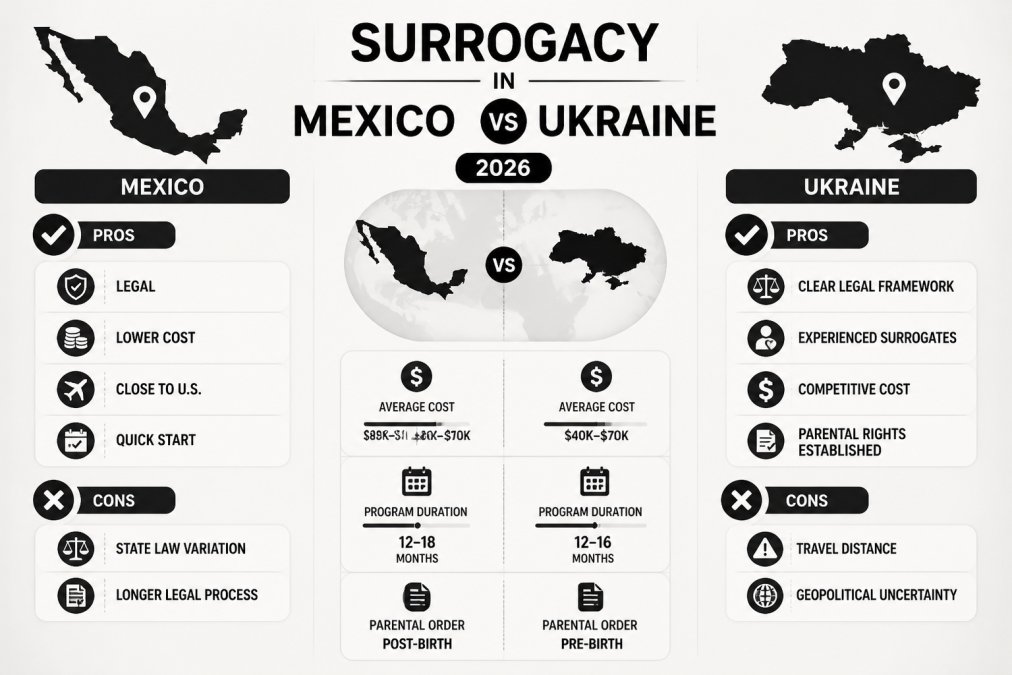
Ukraine offers clear commercial surrogacy laws, affordable costs ($40,000-$65,000), and explicit recognition of Intended Parents’ rights from conception. Pre-birth orders are straightforward to obtain, and success rates are competitive with Western standards.
The critical issue is geopolitical instability. Military conflict has disrupted clinic operations, made travel uncertain, and created complications for repatriation. While some clinics continue operating, the risk profile has changed significantly since 2022. Many practitioners recommend postponing Ukraine-based surrogacy until the situation stabilizes.
Mexico: Growing Accessibility for International Parents
Mexico’s approach to surrogacy is fragmented because family law falls under state jurisdiction. Some states explicitly permit commercial surrogacy (Tabasco, Sinaloa, Coahuila), while others restrict it. This creates legal uncertainty: a valid arrangement in one state may not be recognized in another.
Tabasco has become the de facto hub for international surrogacy in Mexico, with established clinics and legal frameworks. Costs range from $60,000 to $100,000, with timelines of 14-20 months. Mexico permits married heterosexual couples and, in some states, unmarried couples. LGBTQ+ eligibility remains unclear and varies by state.
Colombia: Emerging Destination with Legal Clarity
Colombia explicitly permits commercial surrogacy and recognizes Intended Parents as legal parents from conception. The legal framework is clear and uniform nationwide. Costs range from $55,000 to $85,000, with timelines of 13-18 months. Medical infrastructure in Bogotá and Medellín meets international standards.
Colombia’s advantage is legal clarity combined with affordability. Unlike Mexico, there is no state-by-state variation. For Intended Parents seeking a middle ground between US legal certainty and lower costs, Colombia offers a reasonable compromise.
Eligibility restrictions apply: Colombia permits married heterosexual couples and, in some cases, unmarried couples, but LGBTQ+ surrogacy remains legally uncertain.
Greece and Albania: European Alternatives
Greece permits altruistic (non-commercial) surrogacy only, meaning surrogate compensation is prohibited. This significantly limits access because finding surrogates willing to undergo medical procedures without compensation is difficult. Costs typically range from $70,000 to $110,000 because medical and legal expenses remain high.
Albania has emerged as an alternative with lower costs ($50,000-$80,000) and explicit commercial surrogacy laws, but the medical infrastructure is less established than in Georgia or Colombia, and fewer international Intended Parents have experience with Albanian clinics.
Both restrict surrogacy eligibility to married heterosexual couples.
Armenia: Lower-Cost Option with Legal Recognition
Armenia explicitly permits commercial surrogacy and recognizes Intended Parents as legal parents from conception. Costs range from $35,000 to $55,000, making Armenia one of the most affordable options globally. Medical facilities in Yerevan are competent, though less internationally renowned than Georgian or Ukrainian clinics.
The trade-off is limited international track record. Fewer Intended Parents have pursued surrogacy in Armenia, so fewer case studies exist compared to more established destinations.
Armenia restricts eligibility to married heterosexual couples.
Cost of International Surrogacy: What to Expect by Destination
The cost of international surrogacy varies dramatically by destination, and understanding what is included is essential to avoid surprise expenses.
In the United States, the $150,000-$250,000 range typically includes surrogate compensation ($25,000-$35,000), IVF procedures and medications ($15,000-$25,000), legal counsel ($10,000-$15,000), agency coordination fees ($15,000-$25,000), and psychological screening ($3,000-$5,000). Travel and accommodation add another $5,000-$10,000.
In Georgia, the $50,000-$70,000 range is genuinely more comprehensive. Most clinics bundle surrogate compensation, medical procedures, legal documentation, and basic travel coordination. Travel and accommodation remain your responsibility and add $3,000-$5,000.
In Ukraine, similar all-inclusive models apply, though geopolitical uncertainty now creates additional costs for contingency planning and travel insurance.
In Mexico, Colombia, and Armenia, costs fall between Georgia and the United States, but transparency varies by clinic. Always request itemized breakdowns before committing.
The cheapest option is not always the safest, and the most expensive option does not guarantee the smoothest process. Choose based on your family structure, legal requirements, and risk tolerance, not price alone.
Surrogacy for Gay Couples Abroad: Legal Eligibility by Country
Surrogacy for gay couples abroad is legally possible in only two of the seven destinations covered here: the United States and, with caveats, Colombia.
The United States explicitly permits same-sex couples to pursue surrogacy in surrogacy-friendly states. Both members of a couple can be named on the pre-birth parentage order, and no post-birth adoption is required.
Colombia permits surrogacy for unmarried couples in some cases, which can include same-sex couples, but the legal landscape is less explicit than in the US. Legal counsel familiar with Colombia’s current interpretation is essential.
Every other destination either explicitly restricts surrogacy to married heterosexual couples or maintains legal ambiguity that makes same-sex surrogacy risky. For LGBTQ+ Intended Parents, the United States remains the safest choice despite its cost.
Ethical International Surrogacy: Ensuring Safe, Transparent Practices
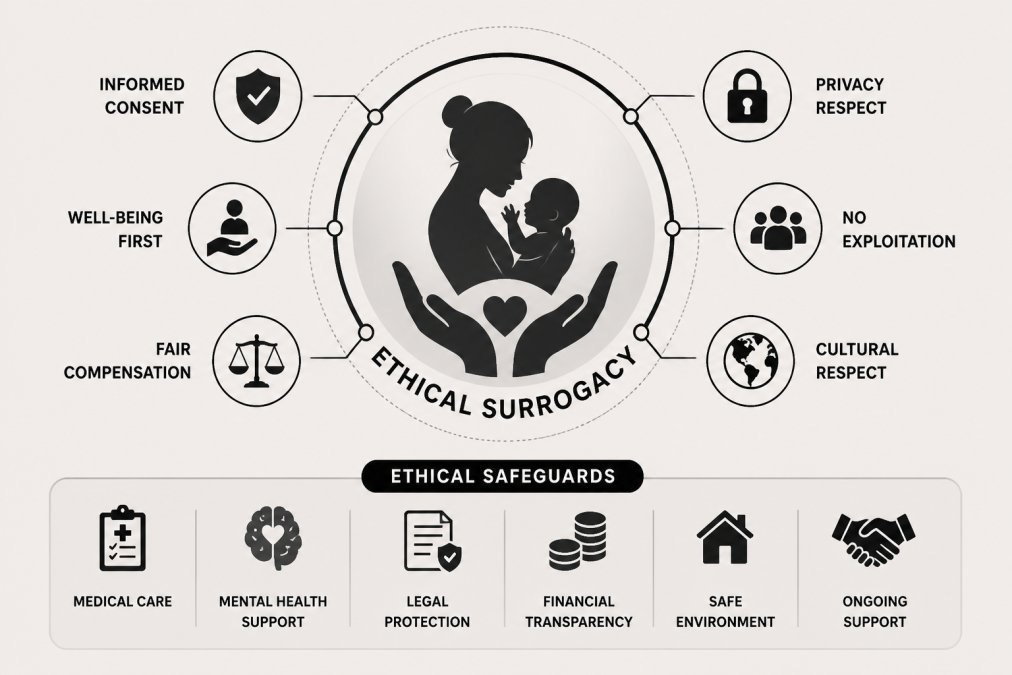
Ethical international surrogacy requires more than legal compliance; it demands that Intended Parents verify surrogate welfare, clinic transparency, and genuine informed consent.
Red flags signal unethical operators: clinics that rush matching, agencies that refuse to disclose surrogate compensation or working conditions, programs that pressure Intended Parents to choose cheaper options without explaining legal trade-offs, and arrangements where the surrogate is isolated or unable to communicate directly with Intended Parents.
Ethical practices include clear surrogacy agreements drafted by independent legal counsel for both parties, medical screening that prioritizes surrogate health, transparent compensation that meets or exceeds local standards, psychological counseling for surrogates before and after pregnancy, and direct communication channels between Intended Parents and surrogates.
Tax, Insurance, and Repatriation: Often-Overlooked Legal Considerations
Most Intended Parents focus on medical costs and legal parentage, but three overlooked areas create substantial complications: tax implications, insurance coverage, and repatriation logistics.
Tax implications vary by country. In the United States, surrogate compensation is generally not tax-deductible for Intended Parents. In many international destinations, tax treatment is unclear, creating risk of unexpected liability. Consult a tax professional familiar with cross-border surrogacy before committing.
Insurance is equally complex. Most standard health insurance policies exclude surrogacy-related claims. Intended Parents must obtain separate coverage for the surrogate’s medical care, pregnancy complications, and delivery. Many international destinations require Intended Parents to carry liability insurance in case the surrogate is injured.
Repatriation, bringing your newborn home with proper legal documentation, is where many Intended Parents encounter unexpected delays. Even if parentage is established in the surrogacy destination, your home country may not recognize that order automatically. You may need to obtain a consular certificate, register the birth with your home country’s embassy, or pursue post-birth adoption in your home jurisdiction.
Engage legal counsel in both your home country and the surrogacy destination before the pregnancy begins to identify documentation requirements and ensure your child’s citizenship is clear.
Which Destination Is Right for Your Family?
Choosing the best legal destinations for international surrogacy depends on four factors: your family structure, budget, timeline, and risk tolerance.
If you are a same-sex couple or single parent, the United States is your only truly safe option. The legal certainty justifies the cost.
If you are a married heterosexual couple with a flexible budget and want maximum legal protection, Georgia offers the best value. Legal frameworks are clear, costs are low, and medical standards are high.
If you are a married heterosexual couple with limited budget and can tolerate slightly more legal ambiguity, Colombia or Armenia are reasonable choices. Both offer clear legal frameworks, affordable costs, and established medical infrastructure.
If you prioritize the absolute lowest cost and can navigate legal complexity, Armenia offers the most affordable pathway, though with less international track record than alternatives.
Avoid Ukraine unless geopolitical stability significantly improves. The legal framework is strong, but operational risk is currently too high.
For Mexico, work only with clinics in surrogacy-friendly states (Tabasco) and engage Mexican legal counsel to verify state-specific documentation requirements.
Building your family through international surrogacy requires navigating legal systems, medical protocols, and ethical complexities across borders. The right destination depends on your specific circumstances, family structure, budget, and how much legal certainty you need. Herman Family Group specializes in matching Intended Parents with legally sound destinations, providing comprehensive medical and emotional support from initial planning through birth and beyond, and ensuring your child’s citizenship and parentage are unambiguous before you bring them home. Create My Plan and let our team guide you toward the destination and process that’s right for your family.
Research & External Sources
The legal and medical information in this guide draws from multiple authoritative sources on international surrogacy law and practice. According to the American Society for Reproductive Medicine (ASRM), surrogacy laws vary dramatically by jurisdiction, and Intended Parents must engage legal counsel familiar with both the surrogacy destination and their home country’s recognition requirements. The International Council on Infertility Information Dissemination (INCIID) provides comprehensive resources on surrogacy regulations across multiple countries and tracks changes to international law affecting Intended Parents. Additionally, the European Society of Human Reproduction and Embryology (ESHRE) publishes guidelines on ethical surrogacy practices and medical standards across European and international destinations.
Frequently Asked Questions
Which countries have the most favorable surrogacy laws for international Intended Parents?
The United States (especially California) offers the strongest legal protections with pre-birth parentage orders available regardless of marital status or sexual orientation. Georgia provides progressive laws with full legal recognition from conception and significantly lower costs. Mexico and Colombia have increasingly accessible frameworks for international Intended Parents. Each destination balances legal security, cost, and eligibility differently, your family structure and priorities determine the best fit.
What are the key differences in international surrogacy laws by country?
The USA prioritizes Intended Parent protection through pre-birth orders and state-level enforcement. Georgia and Armenia recognize Intended Parents as legal parents from conception. Ukraine has an established framework but faces current geopolitical complexities. Mexico and Colombia offer growing accessibility with varying eligibility requirements. Greece and Albania provide European alternatives with moderate legal clarity. Eligibility often depends on marital status, sexual orientation, and nationality, requirements differ significantly across borders.
How much does international surrogacy cost in different countries?
Costs vary dramatically by destination. Armenia, Kyrgyzstan, and Ukraine range from $34,000-$65,000. Georgia costs $41,500-$80,000. Mexico and Colombia typically range $50,000-$100,000. The United States ranges $150,000-$250,000 due to higher medical, legal, and surrogate compensation standards. Costs include medical procedures, surrogate compensation, legal documentation, and agency fees. Lower-cost destinations may offer fewer legal protections or eligibility restrictions, so compare total value, not price alone.
Which countries allow surrogacy for same-sex couples and single parents?
The United States (California especially) and Georgia explicitly permit surrogacy for LGBTQ+ couples and single parents with full legal recognition. Mexico and Colombia increasingly support same-sex Intended Parents, though regional variations exist. Ukraine, Armenia, and Albania have restrictions, typically limiting surrogacy to married heterosexual couples. Greece permits gestational surrogacy for married couples (including same-sex) in some regions. Before choosing a destination, verify current laws for your family structure, as regulations evolve and eligibility varies by clinic and jurisdiction.
What ethical safeguards should I look for in an international surrogacy program?
Ethical international surrogacy programs ensure surrogate health screening, psychological counseling, independent legal representation for both Intended Parents and surrogates, transparent compensation, and clear surrogacy agreements signed before embryo transfer. Verify that clinics follow international medical standards, provide comprehensive medical and emotional support through birth and beyond, and maintain transparent, no-hidden-fee pricing. Reputable agencies specialize in legally sound destinations and offer personalized coordination, avoiding exploitation while protecting your family's legal rights and the surrogate's wellbeing.
This article was written using GrandRanker