Table of Contents
- How to Find Reputable International Surrogacy Agencies: Key Criteria
- International Surrogacy Laws by Country: Legal Risk Assessment
- International Surrogacy Agencies Reviews: What to Evaluate
- Medical screening and IVF clinic partnerships
- Cost of International Surrogacy: Financial Transparency Audit
- Ethical International Surrogacy: Standards and Red Flags
- Questions to Ask Before Selecting a Surrogacy Agency
- Comparing Agency vs. Independent Surrogacy: Vetting Pathways
- Common Mistakes When Finding Reputable International Surrogacy
- Conclusion: Your Surrogacy Agency Selection Roadmap
Find Reputable International Surrogacy: A Vetting Guide
Last Updated: July 15, 2026
How to Find Reputable International Surrogacy Agencies: Key Criteria
Learning how to find reputable international surrogacy requires understanding what separates trustworthy agencies from those cutting corners. At Herman Family Group, we’ve spent over a decade helping Intended Parents navigate this critical decision, and the patterns are unmistakable, the best agencies operate with complete transparency and verifiable track records. Below, we’ll show you exactly how to evaluate surrogacy agencies across the criteria that actually matter: public accountability, demonstrated experience, and ethical standards that protect both Intended Parents and gestational carriers.
The surrogacy landscape has shifted dramatically. Ten years ago, finding reputable international surrogacy meant trusting word-of-mouth and hoping for the best. Today, it means demanding evidence. Agencies worth your time stand behind their work publicly, maintain detailed records of outcomes, and partner with medical institutions that meet international standards.
Agency Transparency and Public Accountability
Transparency separates reputable international surrogacy agencies from those hiding problems. When an agency won’t disclose basic information about their operations, that’s your first red flag.
Real transparency looks like this: published success rates broken down by age and diagnosis, named IVF clinic partnerships with verifiable credentials, clear escrow account structures, and documented psychological support protocols. An agency that operates in the shadows, vague about where transfers happen, evasive about costs, reluctant to share client references, is protecting something.
It’s important to choose people who stand behind the brand and who are public like we are. Agencies that maintain public accountability through published reviews, transparent pricing pages, and named medical partnerships demonstrate confidence in their work. When you call an agency and they can’t immediately name their partner clinics or explain their fee structure without hedging, that hesitation tells you something.
Look for agencies that publish their contract templates online. Yes, templates. Not every contract is identical, but reputable agencies let you review their standard terms before committing. This simple act, making documents public, filters out operators who rely on information asymmetry to maintain control.
Track Record and Verifiable Experience
Experience matters, but not all experience is equal. An agency that’s been operating for fifteen years with a 40% success rate is less valuable than one operating for five years with a 75% rate.
Ask for specific numbers: How many Intended Parents have they served? What percentage achieved live birth? How many gestational carriers have they worked with, and what’s their retention rate? Agencies with strong track records can answer these questions precisely because they track them obsessively.
The best signal is longevity among gestational carriers. If surrogates work with an agency once and never return, something’s wrong with how that agency treats them. Conversely, agencies where carriers return for multiple journeys indicate ethical practices, fair compensation, and genuine support.
Request references from Intended Parents who completed their journey 2-3 years ago, not just recent ones. Recent clients are still in the honeymoon phase. Talk to people far enough past birth to assess whether the agency’s support actually continued as promised. Ask them: Did costs stay as quoted? Did the agency respond when complications arose? Would they recommend this agency to a friend?
International Surrogacy Laws by Country: Legal Risk Assessment
This is where most guides fail Intended Parents. They list countries without explaining the legal landmines buried beneath each jurisdiction. Reputable international surrogacy agencies help you navigate these risks; bad ones ignore them until you’re mid-journey and discovery hits.
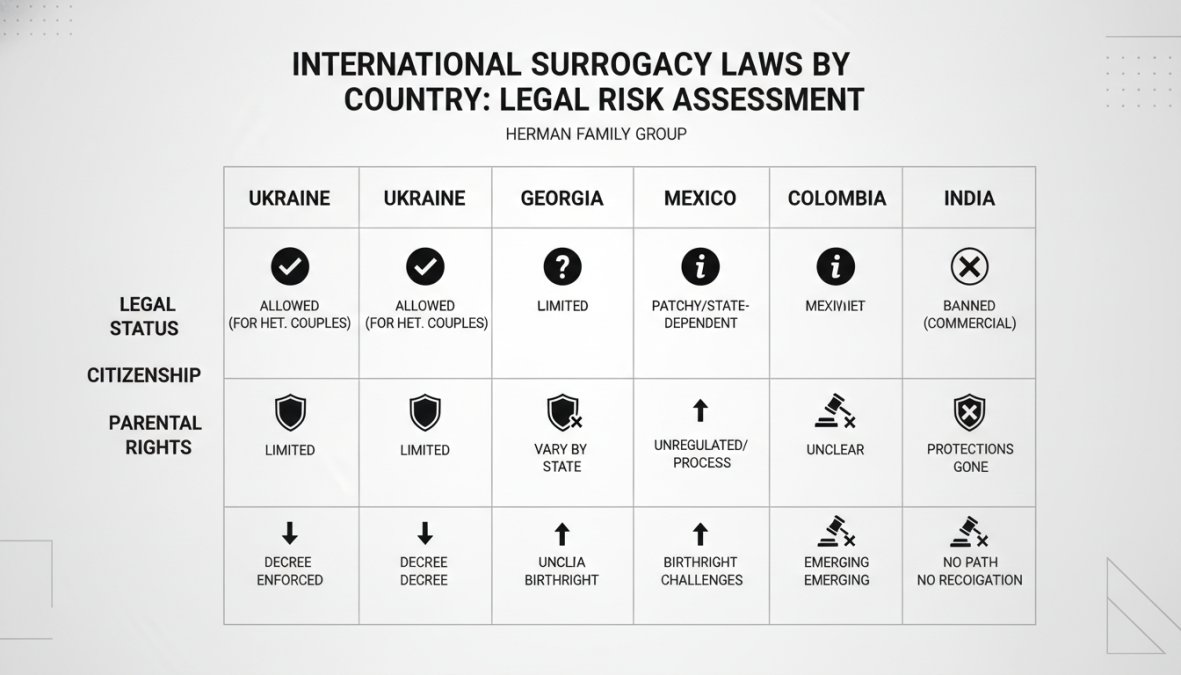
Legal frameworks for surrogacy vary wildly. Some countries recognize gestational surrogacy as legal and enforceable. Others tolerate it but won’t recognize parental rights. Still others ban it outright but don’t prosecute. Understanding which category applies to your destination is non-negotiable.
Understanding Legal Parentage and Citizenship
The moment your child is born, three legal questions activate simultaneously: Who is the legal parent? What is the child’s citizenship? How do you get a birth certificate that allows travel?
In countries like Ukraine and Georgia, surrogacy law explicitly recognizes Intended Parents as legal parents from conception or birth. The gestational carrier has no claim. This clarity is rare and valuable. In Mexico and Colombia, laws are more ambiguous, some states recognize surrogacy, others don’t, and parental rights may require additional court proceedings. In India, the regulatory environment has shifted multiple times, creating uncertainty even for ongoing cases.
Citizenship is equally critical. A child born in Ukraine to non-Ukrainian parents doesn’t automatically gain Ukrainian citizenship. But they also don’t automatically gain your citizenship either. You’ll need to apply for citizenship in your home country, which requires a valid birth certificate and proof of parentage. If the birth certificate lists you as the parent, this process is straightforward. If it lists the gestational carrier, you’ll need to navigate adoption or guardianship proceedings, expensive, time-consuming, and legally risky.
Some countries won’t recognize surrogacy-derived parentage at all. If you’re a single parent or same-sex couple, certain jurisdictions will refuse to process your paperwork. This isn’t theoretical, it’s the reason some Intended Parents end up in legal limbo, unable to bring their child home.
Post-Birth Legal Documentation Roadmap
This is the part agencies often gloss over, but it determines whether you actually get your child home legally.
After birth, you need: a birth certificate naming you as parent (or naming the surrogate, which complicates everything), a DNA test confirming biological parentage if required, an apostille (international certification) of the birth certificate, a passport or travel document for the child, and a visa or entry permit for your home country. This sequence matters. Do them out of order and you create delays.
Some countries require a court order confirming parentage before issuing a birth certificate. Others issue the certificate first and require court confirmation later. Timing determines whether you can take your child home immediately after birth or whether you’re stuck in the destination country for weeks waiting for paperwork.
The best agencies maintain relationships with local legal counsel in their destination countries. They’ve done this hundreds of times. They know which courts move fast, which officials require specific documentation formats, and which steps can be compressed. They also budget for delays, because they happen.
Reputable international surrogacy agencies provide a documented legal roadmap before you start, not improvised guidance after birth. You should know exactly what documents you’ll need, in what order, and how long each step typically takes.
International Surrogacy Agencies Reviews: What to Evaluate
Evaluating agencies means looking past marketing language and assessing actual operational capability. This section breaks down the evaluation framework used by Intended Parents who’ve successfully navigated international surrogacy.

Medical Screening and IVF Clinic Partnerships
The quality of your medical care depends entirely on the IVF clinic the agency partners with. A reputable agency doesn’t just have any clinic, they have clinics with strong track records, transparent success rates, and experience managing Intended Parents from abroad.
Ask the agency: What are the partner clinic’s success rates? How are they calculated? Are they reported to SART (Society for Assisted Reproductive Technology) or equivalent? What’s the miscarriage rate? What’s the live birth rate per embryo transfer?
Success rates vary dramatically by clinic, by patient age, and by diagnosis. A clinic reporting 60% success for patients under 35 is strong. The same clinic reporting 35% for patients over 40 is also realistic. What matters is that they’re transparent about the breakdown.
Medical screening should include comprehensive testing: infectious disease panels, genetic screening if relevant, hormone levels, and uterine evaluation via ultrasound. The clinic should provide written results to both the Intended Parents and the gestational carrier. If the clinic won’t share medical records with the carrier, that’s a sign they’re not prioritizing her health.
Reputable international surrogacy agencies maintain long-term relationships with 2-4 partner clinics maximum. They know these clinics inside-out. They can tell you which clinic is best for your specific situation, not just which one has availability. Agencies that work with dozens of clinics are playing a numbers game, not optimizing for your outcome.
Cost of International Surrogacy: Financial Transparency Audit
Cost is where Intended Parents get blindsided most often. An agency quotes $45,000, you commit, and suddenly there are “additional medical costs,” “carrier compensation adjustments,” and “unforeseen legal fees” that weren’t mentioned upfront.
Reputable international surrogacy agencies provide itemized cost breakdowns before you sign anything. Not estimates, actual costs or tight ranges. The breakdown should include: carrier compensation, medical procedures (egg retrieval, embryo transfer, monitoring), IVF lab fees, legal fees (both countries), travel and accommodation, insurance, and contingency reserves.
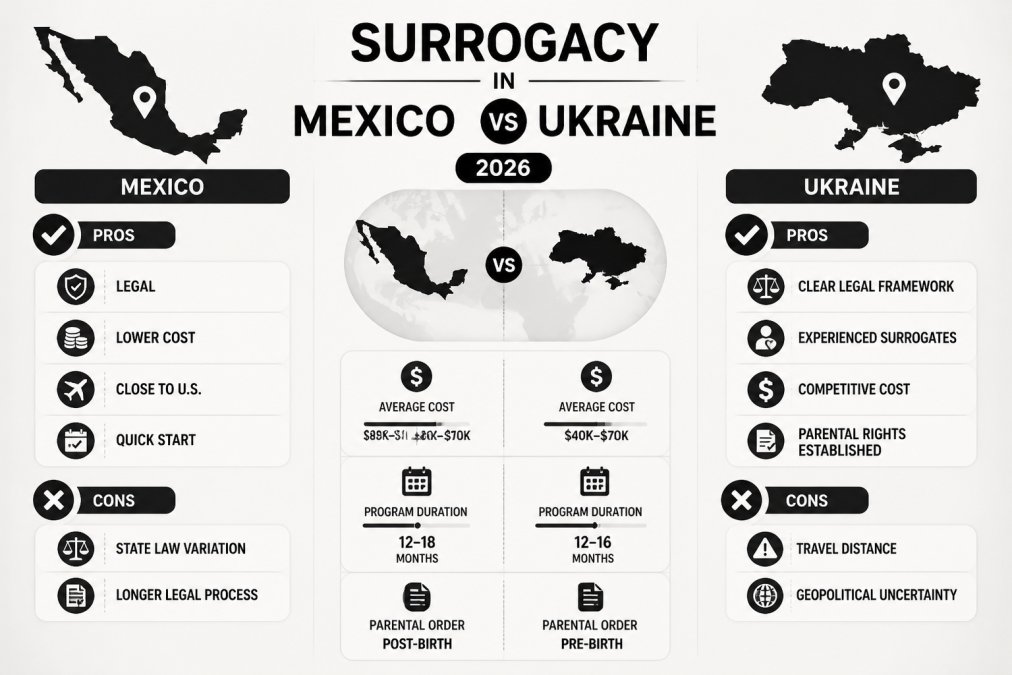
Some costs are fixed. Carrier compensation in Ukraine is typically $12,000-$15,000. Embryo transfer costs are predictable. Legal fees in established jurisdictions are standardized. Other costs vary: travel duration depends on your situation, medical complications affect procedure counts, and clinic pricing differs.
Hidden Fee Detection and Escrow Account Protection
Hidden fees emerge from vague cost categories. Watch for these red flags:
“Agency coordination fees” that are undefined. How much? What does it include? If the agency can’t break it down, it’s probably inflated.
“Medical contingency” that’s 20% of total cost. Some contingency is reasonable (5-10%). Excessive contingency suggests the agency is uncertain about actual costs or is padding the budget.
“Carrier support” that’s listed as a lump sum with no breakdown. Does it include psychological counseling? Housing? Transportation? Insurance? These should be itemized.
Escrow accounts protect you. A legitimate agency holds your funds in an independent escrow account, releasing them only as services are delivered. If the agency asks you to wire money directly to them, or to the clinic, or to the carrier, you’ve lost use if something goes wrong.
Reputable international surrogacy agencies provide escrow documentation showing: the account holder (independent third party), the release conditions (what triggers payment), and the timeline (when funds are released). You should be able to contact the escrow agent directly.
Ethical International Surrogacy: Standards and Red Flags
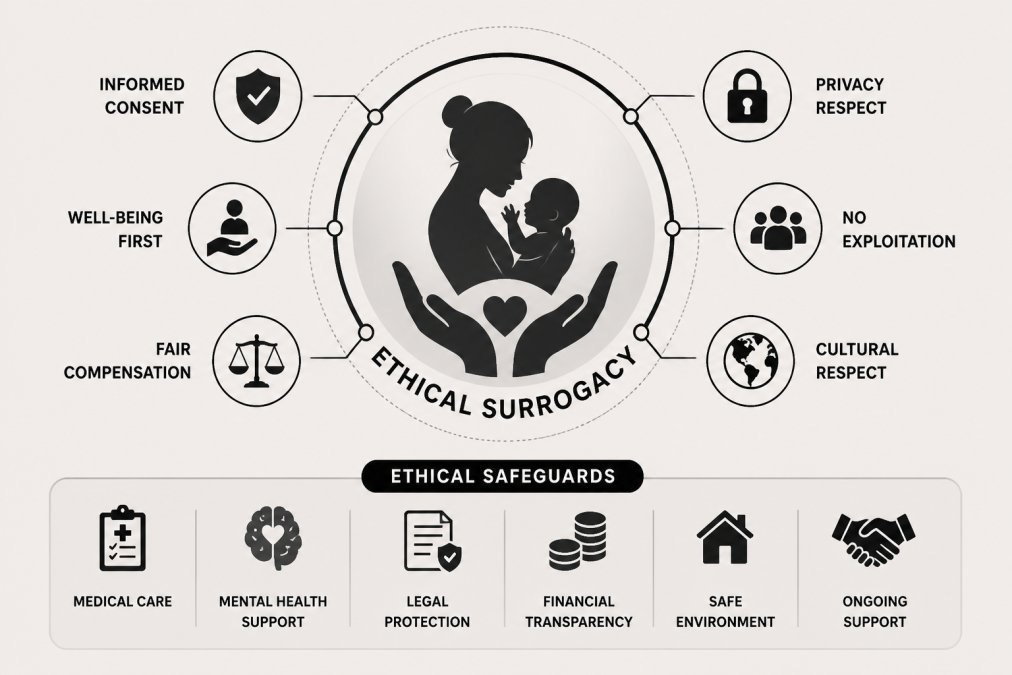
Ethical surrogacy means both Intended Parents and gestational carriers enter the journey fully informed, with genuine autonomy, and with protection if complications arise.
Gestational Carrier Welfare and Psychological Support
The carrier’s welfare isn’t separate from your success, it’s foundational to it. A carrier who feels exploited, unsupported, or psychologically distressed is at higher risk for complications, regret, or legal disputes.
Ethical standards require: independent psychological evaluation before matching, ongoing counseling throughout pregnancy, clear communication protocols between carrier and Intended Parents, and post-birth support including debriefing and mental health monitoring.
Some agencies minimize carrier support to reduce costs. They provide a single psychological evaluation, minimal counseling, and assume the carrier is fine after birth. This is penny-wise, pound-foolish. Carriers with unprocessed feelings often develop attachment issues or regret that can escalate into legal disputes months or years later.
The best agencies treat surrogacy as a relationship, not a transaction. Carriers should feel seen, valued, and supported. This costs money, good psychological support isn’t cheap. Agencies that invest in it demonstrate commitment to ethical practice.
Red flags include: carriers reporting they were pressured to hide health issues, carriers describing inadequate medical care during pregnancy, carriers saying they had no contact with Intended Parents, and carriers expressing regret or feeling used after birth.
Questions to Ask Before Selecting a Surrogacy Agency
Before committing to an agency, you need answers to these specific questions. Don’t accept vague responses.
Track Record:
- How many successful live births have you facilitated in the past three years?
- What’s your success rate by age group?
- Can you provide references from Intended Parents who completed their journey 2-3 years ago?
- How many gestational carriers have worked with you, and how many have returned for additional journeys?
Legal Framework:
- Which countries do you operate in, and what’s the legal status of surrogacy in each?
- What’s your post-birth legal process? Can you provide a written timeline?
- If parental rights are challenged, what’s your legal recourse?
- What happens if the child is born with a disability or health condition the Intended Parents didn’t anticipate?
Medical Partnerships:
- Which IVF clinics do you partner with?
- What are their published success rates?
- Can the Intended Parents and carrier communicate directly with the clinic?
- How are medical complications handled?
Carrier Screening and Support:
- What’s your psychological evaluation protocol?
- What ongoing counseling do you provide?
- How do you ensure carriers are genuinely willing, not financially desperate?
- What happens if a carrier changes her mind after matching?
Costs and Transparency:
- Can you provide an itemized cost breakdown?
- What’s included in your quoted price, and what costs extra?
- How is the escrow account structured?
- What happens to funds if the journey doesn’t result in a live birth?
Support for Intended Parents:
- What support do you provide before, during, and after pregnancy?
- How do you handle communication between Intended Parents and the carrier?
- What’s your protocol if complications arise during pregnancy?
- Do you provide support after birth, including legal documentation?
Comparing Agency vs. Independent Surrogacy: Vetting Pathways
Some Intended Parents pursue independent surrogacy, finding a carrier outside an agency structure. This approach offers lower costs and more control, but it introduces significant legal and emotional risks.
Agency Surrogacy Advantages:
- Screened, psychologically evaluated carriers
- Established legal frameworks
- Medical coordination across multiple providers
- Built-in dispute resolution
- Post-birth support and documentation
Agency Surrogacy Disadvantages:
- Higher costs (agencies add markup for coordination)
- Less control over carrier matching
- Standardized processes that may not fit your situation
Independent Surrogacy Advantages:
- Lower costs (no agency middleman)
- Direct relationship with the carrier
- Flexibility in arrangement terms
Independent Surrogacy Disadvantages:
- You’re responsible for carrier screening (psychological evaluation, background checks, fertility history)
- You must navigate medical coordination yourself
- You must hire separate legal counsel in the destination country
- If disputes arise, you have no mediation structure
- Post-birth documentation is entirely your responsibility
- Higher risk of carrier regret or legal claims
Comparison | Agency Surrogacy | Independent Surrogacy |
|---|---|---|
Carrier Screening | Professional evaluation | Your responsibility |
Medical Coordination | Agency manages | You coordinate |
Legal Support | Built-in | You hire counsel |
Cost | $50,000-$80,000+ | $30,000-$60,000+ |
Dispute Resolution | Agency mediation | Court proceedings |
Post-Birth Support | Included | Your responsibility |
Best For | First-time Intended Parents, complex cases | Experienced Intended Parents with strong carrier relationships |
For most Intended Parents, agency surrogacy is the safer path. The additional cost buys coordination, screening, and protection. Independent surrogacy works only if you have substantial experience navigating international fertility law and genuine comfort with legal ambiguity.
Common Mistakes When Finding Reputable International Surrogacy
These errors appear repeatedly among Intended Parents who chose poorly.
Mistake 1: Prioritizing cost over track record. The cheapest agency isn’t the best value. An agency charging $45,000 with a 50% success rate costs more per live birth than an agency charging $65,000 with a 75% success rate. Calculate cost-per-success, not total price.
Mistake 2: Ignoring the gestational carrier’s experience. If you learn the carrier has had multiple miscarriages, or has never carried a pregnancy to term, that’s a warning sign. Carriers with strong obstetric histories are more likely to succeed.
Mistake 3: Skipping the legal review. Hiring an independent lawyer to review the surrogacy contract before signing is non-negotiable. The $2,000-$3,000 you spend on legal review saves you from $50,000+ in complications.
Mistake 4: Not discussing contingencies upfront. What happens if the embryo doesn’t implant? If the pregnancy results in miscarriage? If the child is born with a disability? The agency should have clear answers, not improvise mid-crisis.
Mistake 5: Choosing an agency that won’t share references. Any agency worth trusting will provide contact information for past clients. If they refuse, there’s a reason.
Mistake 6: Assuming lower costs mean lower quality. This isn’t always true. Agencies in emerging markets (Ukraine, Georgia, Mexico) often deliver excellent outcomes at lower costs than U.S.-based agencies. What matters is track record, not location.
Choosing how to find reputable international surrogacy comes down to one principle: demand evidence. Evidence of success, evidence of ethical practice, evidence of transparency. Agencies that operate publicly, with named partnerships and verifiable outcomes, are betting their reputation on results. That’s the signal you’re looking for.
Herman Family Group specializes in exactly this framework, transparent pricing with no hidden fees, verifiable medical partnerships, and comprehensive support from planning through birth and beyond. We help Intended Parents navigate international surrogacy with confidence, backed by over a decade of experience and documented outcomes. Ready to explore your options with a team that stands behind their work publicly? Create My Plan and let’s build your path forward.
Frequently Asked Questions
What are the main legal risks of international surrogacy?
Key legal risks include unclear parental rights recognition in your home country, citizenship complications for the child, and enforceability of surrogacy contracts across borders. Working with agencies experienced in post-birth legal documentation and selecting destinations with established legal frameworks for surrogacy significantly reduces these risks. Always ensure your chosen agency provides legal counsel familiar with both the destination country's laws and your home country's requirements for recognizing parental rights and obtaining birth certificates.
What should I look for in an international surrogacy agency regarding ethical standards?
Ethical agencies prioritize gestational carrier welfare with comprehensive medical screening, psychological evaluation, and ongoing support services. They maintain transparent surrogacy contracts that clearly outline all rights and responsibilities, provide independent legal counsel to carriers, and follow ethical surrogacy frameworks. Verify that the agency conducts thorough matching processes, maintains confidentiality, and has systems for addressing disputes fairly. Red flags include pressure to rush decisions, unwillingness to provide references, or vague explanations of carrier support.
How can I identify hidden fees in international surrogacy agency pricing?
Request a detailed, itemized cost breakdown covering all phases: initial consultation, medical screening, IVF procedures, carrier compensation, legal documentation, travel, and post-birth support. Compare what different agencies include in their quoted fees—some bundle services while others charge separately. Ask specifically about escrow account fees, currency exchange charges, and potential additional costs if complications arise. Transparent agencies provide written cost agreements upfront with no hidden fees; if an agency is evasive about pricing details, this is a significant warning sign.
This article was written using GrandRanker