Table of Contents
- Understanding Your Surrogacy Journey: Key Planning Phases
- International Surrogacy Laws by Country: Ukraine, Mexico, and Czech Republic
- International Surrogacy Process Steps: From Screening to Birth
- Cost of International Surrogacy: Budgeting for Your Journey
- Surrogacy Abroad Legal Risks: What You Need to Know
- Essential Planning Checklist: Preparing for Your International Surrogacy
- Conclusion
Last Updated: July 17, 2026
Understanding Your Surrogacy Journey: Key Planning Phases
Planning an international surrogacy journey requires understanding the distinct phases from initial consultation through bringing your baby home. At Herman Family Group, we’ve guided Intended Parents through this complex process for over a decade. The structure remains consistent: medical preparation, legal coordination, travel logistics, and post-birth integration. Each phase demands specific decisions, timelines, and resources that directly impact your experience.
Since 2020, the international surrogacy landscape has shifted significantly. More countries have clarified legal frameworks, fertility clinics have simplified protocols, and Intended Parents now have clearer pathways to parenthood. According to The American Society for Reproductive Medicine, cross-border fertility services have become more transparent and regulated, benefiting families seeking surrogacy abroad.
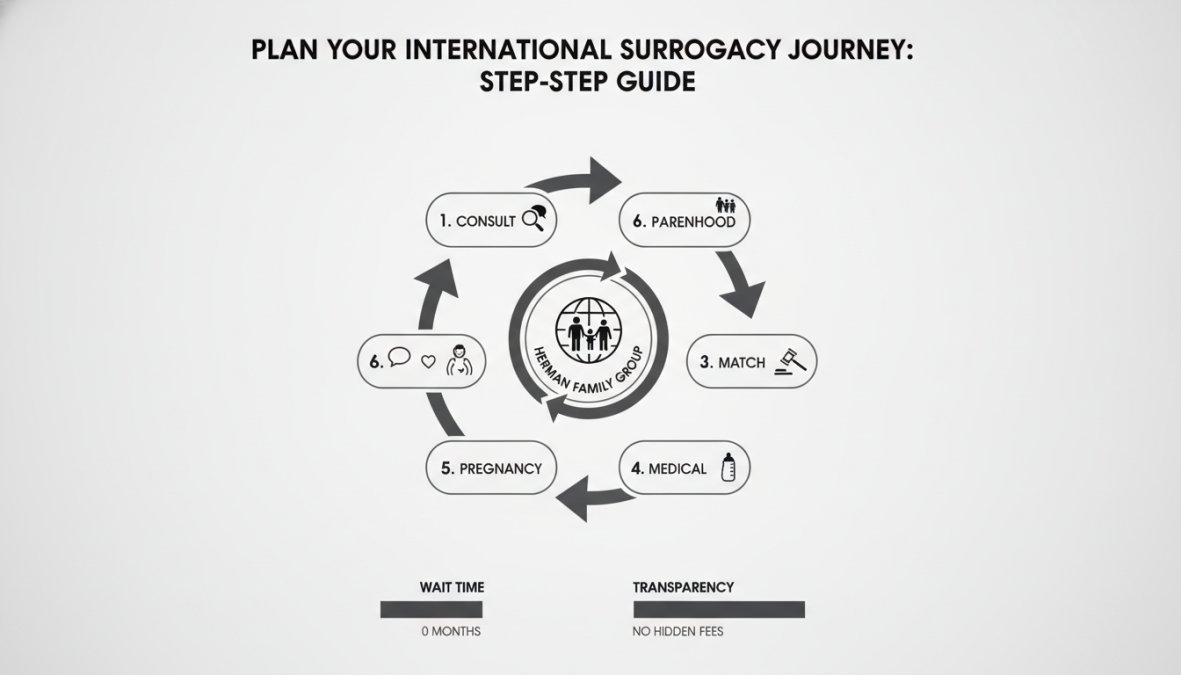
Planning international surrogacy requires building a coordinated strategy across medical, legal, and logistical domains simultaneously. Your legal structure affects which countries you can use, your medical timeline determines your travel schedule, and your budget shapes which destination makes sense.
International Surrogacy Laws by Country: Ukraine, Mexico, and Czech Republic
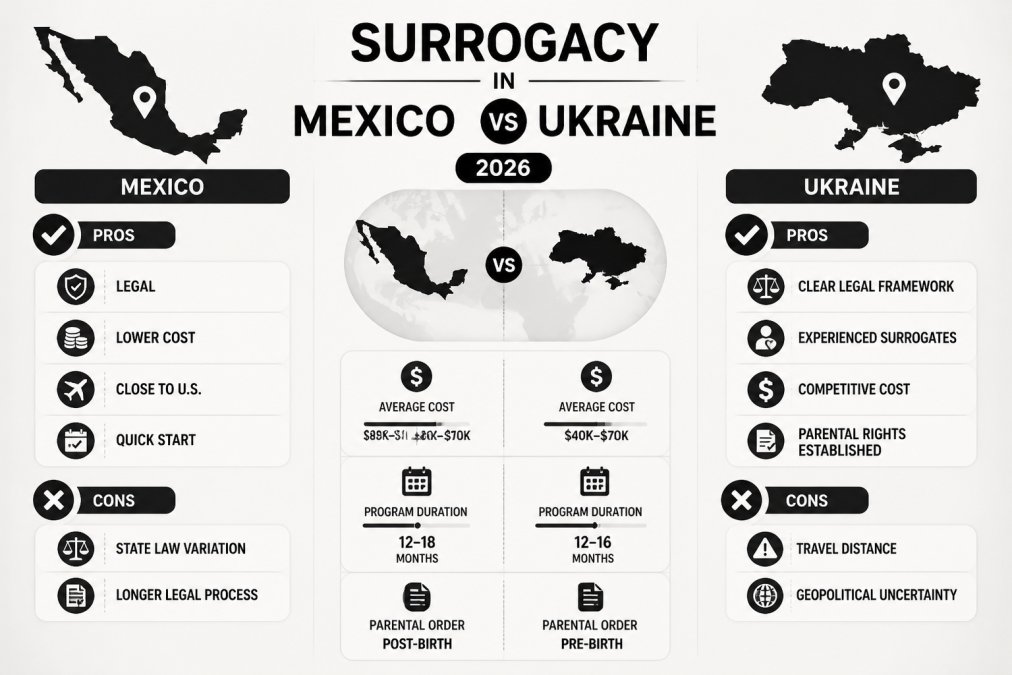
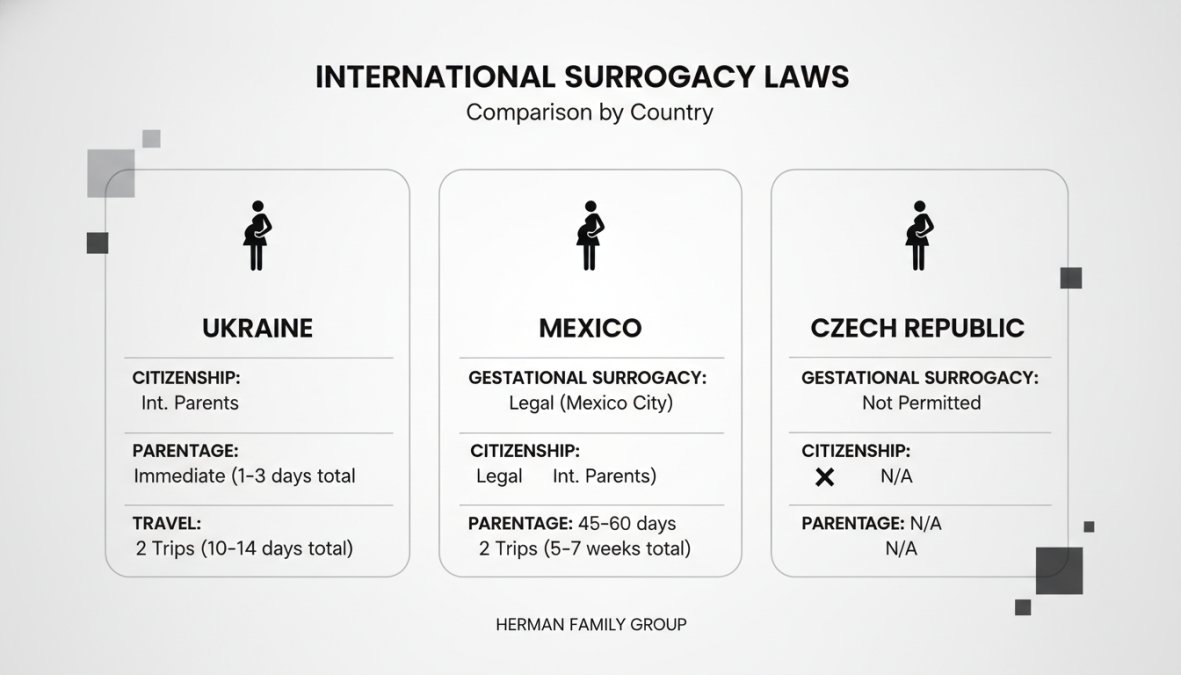
Your choice of destination shapes everything: budget, timeline, legal certainty, and protections available to you as Intended Parents. Three destinations have emerged as leaders: Ukraine, Mexico, and Czech Republic.
Ukraine’s Legal Framework for Gestational Surrogacy
Ukraine is one of the world’s most surrogacy-friendly destinations. Gestational surrogacy is fully legal and regulated, with clear statutory protections for Intended Parents. The country permits surrogacy for married couples.
The legal pathway centers on the declaration of parentage. Once your surrogate delivers, you obtain a court declaration recognizing you as the legal parents, used to apply for your child’s birth certificate and passport. This process typically takes 3-4 days post-delivery. Critically, Ukraine does not require DNA testing when using your own genetic material, simplifying the legal process considerably.
Intended Parents must work with a licensed surrogacy agency and fertility clinic; independent arrangements are not legally recognized. Costs tend to be lower than Western alternatives. Travel requirements include at least two trips: one for embryo transfer (2 days) and one for post-delivery legal processing (10-14 days).
Mexico’s Surrogacy Legal Landscape
Mexico’s surrogacy laws are state-specific, creating both opportunity and complexity. Some states (notably Tabasco, Quintana Roo, and Coahuila) have explicitly legalized gestational surrogacy, while others remain restrictive or ambiguous. Your legal safety depends entirely on which state you choose.
In permissive Mexican states, you work with a local clinic and agency, create embryos, transfer to your surrogate, and obtain legal recognition of parentage. Mexican courts can sometimes issue a declaration of parentage before birth, simplifying post-delivery logistics, though this varies by jurisdiction.
Intended Parents must be extremely careful about state selection. Working with an agency specializing in Mexico and understanding state-level regulations is non-negotiable. Travel requirements: one trip for embryo transfer (3-5 days) and one for post-delivery stay (60 days).
Czech Republic’s Regulations and Requirements
Czech Republic represents a newer option with clearer legal structures than Mexico and competitive pricing compared to Ukraine. Gestational surrogacy is legal and regulated under Czech family law, permitting married couples and unmarried partners; single individuals face more restrictions depending on citizenship.
The Czech legal process requires a formal surrogacy agreement drafted by Czech legal counsel and approved by the court before embryo transfer. After birth, you obtain a declaration of parentage through Czech courts, typically within 2-4 weeks. DNA testing is required to establish biological parentage, providing legal clarity.
Czech clinics are known for high medical standards and transparent international protocols. Travel requirements are moderate: one trip for transfer (3-5 days) and one for post-delivery processing (10-14 days).
International Surrogacy Process Steps: From Screening to Birth
How to plan international surrogacy operationally requires understanding the four core medical and logistical phases.
Step 1: Medical Screening and Fertility Assessment
Your surrogacy journey begins with comprehensive fertility assessment. You’ll undergo blood work, hormone testing, and genetic screening if applicable. The clinic evaluates egg quality, sperm quality, and overall reproductive health. This phase typically takes 2-4 weeks and can often be completed with your local fertility clinic, with results sent to your international clinic.
If you require donor eggs or sperm, the clinic will guide you through donor selection. Most international clinics maintain databases of screened, healthy donors with profiles including medical history, genetic screening results, physical characteristics, and educational background. This selection process adds 1-2 weeks to your timeline.
Step 2: Screening and Matching with a Gestational Surrogate
Once your medical profile is complete, your clinic and surrogacy agency begin the surrogate matching process. Surrogates in regulated programs undergo extensive screening: blood work, infectious disease testing, uterine imaging, psychological evaluation, and background checks. The matching process typically takes 2-6 weeks.
Once matched, you’ll typically have a video consultation with your surrogate to establish rapport and confirm mutual understanding of the surrogacy agreement. Your agreement is formalized at this stage, outlining roles, responsibilities, compensation, and dispute resolution.
Step 3: Embryo Creation and Transfer
Embryo creation begins with your egg retrieval (if using your own eggs) or receipt of donor eggs. Your partner or sperm donor provides sperm. The clinic fertilizes the eggs and cultures the resulting embryos for 5-6 days. Genetic testing (PGT) may be performed to screen for chromosomal abnormalities if elected.
Your surrogate undergoes hormone preparation to ready her uterus for implantation, typically taking 10-14 days. The timing is coordinated so her uterine lining is optimally prepared when your embryo is ready for transfer.
The embryo transfer is a brief, non-surgical procedure. Your surrogate is lightly sedated, and the embryo is placed in her uterus using a thin catheter. The procedure takes 10-15 minutes. Pregnancy confirmation comes 10-12 days after transfer via blood test, with ultrasound confirmation 1-2 weeks later.
Step 4: Travel Logistics and Post-Delivery Stay
Once pregnancy is confirmed, you’ll coordinate travel for delivery and post-birth legal processing. Most programs require Intended Parents present for the birth and immediate post-delivery period.
Your post-delivery stay typically lasts 10-14 days. During this time, you’ll obtain your child’s birth certificate with your names as parents, apply for your child’s passport through your home country’s embassy or consulate, complete any required DNA testing, and arrange return travel with your newborn.
Post-delivery, you’ll work with your surrogacy agency and legal counsel to finalize all documentation. Your child’s citizenship is typically determined by birthplace and your citizenship. Most countries recognize children born via surrogacy to Intended Parents as biological children for citizenship purposes, but confirm your specific country’s rules before birth.
Cost of International Surrogacy: Budgeting for Your Journey
Budgeting for international surrogacy requires understanding major cost categories and how they vary by destination. Your total spend depends on your destination, whether you use your own eggs, surrogate compensation, and travel.
Cost Category | Ukraine Range | Mexico Range | Czech Republic Range |
|---|---|---|---|
Medical screening & embryo creation | Included in program | Included in program | Included in program |
Surrogate compensation | Included in program | Included in program | Included in program |
Surrogacy agency fees | Included in program | Included in program | Included in program |
Legal & court fees | Included in program | Included in program | Included in program |
Travel (flights, hotels, meals) | $1,000-$5,000 | $4,000-$10,000 | $1,000-$8,000 |
Donor eggs (if needed) | $500-$2,000 | $3,000-$6,000 | $1,000-$2,000 |
DNA testing & immigration | $500-$1,000 | $500-$2,000 | $1,000-$3,000 |
The largest variable is whether you use your own eggs or require donor eggs. Using your own genetic material typically reduces costs by $2,000-$5,000 compared to donor cycles. Travel costs scale with distance from your home country. Surrogate compensation is regulated in Ukraine and Czech Republic, making costs predictable.
At Herman Family Group, we emphasize transparent, no-hidden-fee pricing. Your program cost is defined upfront, eliminating surprise expenses that plague many international surrogacy journeys.
Surrogacy Abroad Legal Risks: What You Need to Know
International surrogacy carries legal risks that don’t exist in domestic arrangements. The most critical is ensuring your child’s citizenship and your legal parentage are recognized in your home country.
Your home country’s laws determine whether it recognizes children born via surrogacy and whether it grants citizenship automatically. Some countries (Canada, Australia, UK) have clear, supportive frameworks. Others (France, Germany, Italy) restrict or prohibit surrogacy, creating complications for citizens who pursue it abroad.
Before choosing your destination, consult with an immigration lawyer in your home country. Confirm that your country recognizes surrogacy-born children as your legal children, your child will be granted citizenship automatically, you can obtain a passport without DNA testing or court orders, and your country recognizes the legal parentage established in your surrogacy destination.
Another legal risk: surrogate disputes. In rare cases, a surrogate may refuse to surrender the baby or demand additional compensation. This is why surrogacy agreements and proper legal counsel are critical. Agreements should clearly state that the surrogate has no parental rights and that Intended Parents are the legal parents from birth. Courts in regulated destinations enforce these agreements consistently.
Choose a surrogacy destination with strong legal frameworks and established court precedent. Ukraine and Czech Republic have extensive case law supporting Intended Parents’ rights.
Essential Planning Checklist: Preparing for Your International Surrogacy
Your planning process should follow this sequence:
- Determine your eligibility. Confirm your home country permits surrogacy and recognizes surrogacy-born children. Consult an immigration lawyer.
- Choose your destination. Compare Ukraine, Mexico, and Czech Republic based on legal certainty, cost, timeline, and your circumstances.
- Select your surrogacy agency. Research agencies thoroughly. Verify credentials, read reviews from past clients, and confirm they specialize in your chosen destination.
- Complete medical screening. Schedule fertility testing with your local clinic. Obtain copies of all results in digital format.
- Engage legal counsel. Hire a family law attorney in your home country and in your surrogacy destination.
- Finalize your program agreement. Review all terms with your agency and legal counsel before signing.
- Prepare for surrogate matching. Understand your agency’s matching process and be ready to review surrogate profiles.
- Plan your post-delivery trip. Arrange travel for the birth and post-delivery legal processing.
- Prepare your home. Set up your nursery, purchase essential baby items, and arrange childcare or parental leave.
- Obtain travel documentation. Ensure your passports are valid and apply for visas if required.
- Coordinate with your employer. Inform your employer of your surrogacy journey and arrange leave for travel and post-birth bonding.
Planning international surrogacy is complex, but it becomes manageable when you break it into phases and understand the legal and medical requirements of your chosen destination. Families who navigate this successfully invest time upfront in understanding their destination’s laws, selecting a reputable agency, and coordinating with experienced legal counsel. Herman Family Group specializes in exactly this kind of coordinated planning, we handle medical logistics, connect you with vetted legal counsel in your destination, and guide you through every phase from initial consultation through bringing your baby home. Our transparent, no-hidden-fee approach means you’ll know your costs upfront and have a clear timeline for each phase. Create My Plan with Herman Family Group today and take the first step toward building your family.
Frequently Asked Questions
What are the main legal requirements for international surrogacy in Ukraine, Mexico, and Czech Republic?
Each country has distinct legal frameworks. Ukraine permits gestational surrogacy for married couples and single individuals, with clear legal parentage established at birth. Mexico's laws vary by state, with some regions offering robust protections and others with legal gaps. Czech Republic allows surrogacy under specific conditions with established legal procedures. All three require medical screening, surrogacy agreements, and proper documentation. Working with legal counsel familiar with each country's requirements is essential to protect your rights and ensure compliance.
How long does it take to plan and complete an international surrogacy journey?
The timeline varies significantly based on your chosen destination and individual circumstances. Generally, the entire process—from initial screening through birth and post-delivery documentation—spans 12-24 months. Medical screening typically takes 2-4 months, surrogate matching 1-3 months, embryo creation and transfer 2-4 months, and pregnancy duration 9 months. Additional time may be needed for citizenship, passport applications, and legal parentage declaration. Planning ahead and working with experienced coordinators helps streamline the process.
What are the main costs involved in international surrogacy, and how should I budget?
International surrogacy costs include surrogate compensation, medical procedures, fertility clinic fees, legal services, travel expenses, and accommodation during required stays. Budgeting depends on your chosen country and specific circumstances. Ukraine, Mexico, and Czech Republic offer varying price points. Beyond direct surrogacy costs, plan for round-trip flights, hotel stays during embryo transfer and birth, visa requirements, and insurance coverage. Visit Herman Family Group's pricing page for transparent, current figures tailored to your situation, as costs vary based on individual needs and destinations.
What are the biggest legal risks of international surrogacy, and how can I minimize them?
Key risks include unclear legal parentage, immigration complications, custody disputes, and changing regulations. Surrogacy abroad legal risks are highest when proper documentation—surrogacy agreements, DNA testing results, birth certificates, and citizenship paperwork—is not secured before returning home. Minimize risks by: (1) hiring experienced legal counsel in both your home country and the surrogacy destination; (2) ensuring all contracts are reviewed before commitment; (3) obtaining DNA testing and declaration of parentage documentation; (4) understanding visa and immigration requirements for bringing your newborn home; (5) verifying that your home country recognizes legal parentage established abroad. Working with reputable agencies reduces exposure to fraud and legal complications.
This article was written using GrandRanker